Skip to content Skip to content
Many PVC edge banding RFQs describe the whole project as if every order behaves the same way. On paper that looks efficient. In real buying work it usually hides the part of the job that actually drives the machine decision. Most factories have a normal production case and then a smaller set of orders that create more pressure: narrower widths, more visible finishes, more demanding finished roll targets, or jobs that expose instability after changeovers. If those edge cases are blended into one broad material story, the supplier may quote the average while the buyer is trying to protect the exposed case.
Short answer: buyers should separate normal jobs from edge cases in the RFQ whenever the difficult cases influence the commercial decision. That does not mean exaggerating the project. It means showing the supplier which orders define daily volume, which orders create complaint risk, and which cases must be read carefully before a machine recommendation is trusted. A good RFQ tells the supplier what is common, what is difficult, and how much commercial weight each case really carries.
If your project includes both normal jobs and exposed edge cases, the supplier should see that split before serious quotation starts. Review the RFQ guide, compare with the PVC application page, and check the PVC machine page before sending one blended material summary.
1. Why this split matters in the first place
Factories often run a broad order mix, but not every part of that mix deserves the same influence over the buying decision. Some jobs are stable, forgiving, and commercially routine. Others are where the plant loses time, confidence, or customer trust. Those harder jobs may be smaller in volume and still deserve more attention because they define the real performance question. If the RFQ does not separate those layers, the supplier can answer accurately for the average case and still miss the reason the project exists.
This matters because machine recommendation is not a classroom exercise. It is a judgment about which part of the production case should carry the most weight. Buyers are often not purchasing for the easiest order. They are purchasing for the job that creates the most business risk if the line handles it badly. A supplier can only make that judgment if the RFQ shows where normal work ends and where exposed work begins.
When the split is stated clearly, later conversations also become easier. Quotation comparison improves, sample discussion becomes more meaningful, and the buyer has a cleaner way to judge whether the supplier has understood the real project or only the broad product category.
2. The average case is useful, but it is not enough
There is nothing wrong with describing the average case. Suppliers need it. It tells them what the plant runs most often, what kind of volume rhythm exists, and which production conditions are normal. The problem starts when the RFQ stops there. Many project failures come from treating the average case as if it were the whole case.
For example, the plant may mostly run widths that are straightforward while a smaller narrow-width family triggers the complaints that drive the investment. Or the bulk of the finish mix may be stable while one exposed finish family creates the commercial pressure. If the RFQ treats all of that as one flat story, the supplier may assume the harder case is marginal or occasional when it is actually central to the decision.
Buyers should therefore think of the average case as the foundation, not the conclusion. It tells the supplier where the project begins. The edge-case section tells the supplier where the recommendation must be tested.
3. What counts as an edge case in PVC edge banding work
An edge case is not just any unusual order. It is a production case that matters disproportionately to machine choice, quotation risk, or complaint exposure. In PVC edge banding work, this often includes narrow widths, more visible or more finish-sensitive jobs, orders with tighter finished roll expectations, repeated changeover rhythms, or replacement scenarios where the old line already shows weakness under certain conditions.
The key point is commercial relevance. A rare order that causes no real pressure does not need to dominate the RFQ. A smaller order family that regularly causes quality complaints or slows production does need special attention. The buyer’s job is to make that distinction visible.
This is where the language in the RFQ has to become more disciplined. Instead of saying only that the project includes difficult jobs, say which ones, why they matter, and whether they are difficult because of width, finish sensitivity, finished roll targets, changeover rhythm, or a combination of those factors.
4. Separate by decision weight, not by technical trivia
Some buyers try to make the RFQ thorough by listing many small variants, but that can create a different problem. The supplier receives lots of detail without any signal about what really matters. A better method is to separate jobs according to decision weight. Which jobs define the normal production case? Which jobs define the exposed case? Which jobs are merely occasional variations that do not carry much buying weight?
That structure helps the supplier understand priority. It prevents the project from looking either too simple or too chaotic. It also gives internal teams a better basis for alignment, because production and purchasing can discuss which cases truly shape the recommendation instead of arguing over an undifferentiated list of widths and materials.
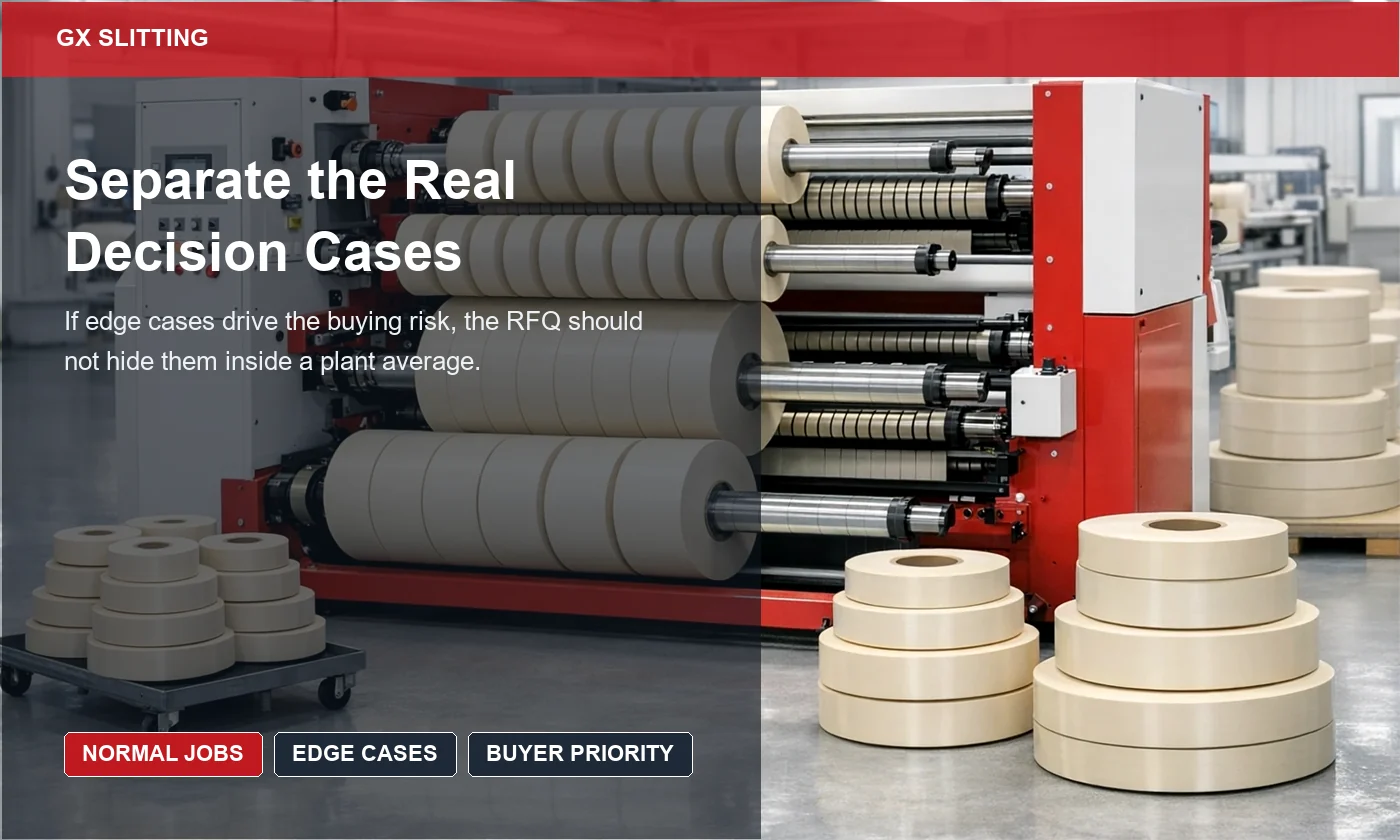
A useful rule is simple: if a case changes how you would judge the supplier’s recommendation, it deserves its own place in the RFQ. If it does not, it probably belongs inside the normal summary rather than as a separate headline.
5. Width families are often the cleanest way to show the split
In many PVC projects, width families are the easiest way to separate normal jobs from edge cases. The plant may run a broad range, but only certain width groups create instability, complaint exposure, or stricter rewind expectations. When that is true, the RFQ should not present the range as one flat number set. It should show which width families are routine and which ones define the exposed part of the project.
This is closely related to the logic in the article on width-group priority. The difference here is that the RFQ is not only ranking importance. It is also describing the project shape. One section says, in effect, “this is what we run most.” Another says, “this is where the recommendation earns trust or loses it.”
That structure improves supplier questions. Instead of asking broadly about width range, stronger suppliers will ask how often the exposed widths appear, what finished roll expectations they carry, and whether the difficult widths are also tied to more visible finishes or more frequent schedule changes.
Practical rule: if one width family drives the complaint risk, do not bury it inside a full-range summary.
6. Finish-sensitive jobs should not hide inside the general material description
Another common failure is hiding finish-sensitive work inside a general PVC description. The material family may look uniform on paper while the commercial risk is not uniform at all. Some finishes tolerate routine handling and broad process variation. Others show marks, edge weakness, or presentation inconsistency much faster. If those jobs matter to the buying decision, they should be separated from the normal case clearly.
The article on finish sensitivity in an RFQ explains how to describe the finish risk itself. This article adds a structural point: finish-sensitive jobs often belong in the edge-case section, not only in a generic materials paragraph. Otherwise the supplier may read them as one more variant rather than as a defining test of the recommendation.
That does not mean every finish-sensitive order deserves equal attention. It means the exposed family should be shown with enough clarity that the supplier understands where the commercial risk rises and why the plant cares.
7. Finished roll targets often reveal whether a case is normal or exposed
Many buyers separate cases by width or finish but forget that finished roll targets can be what truly makes a job exposed. The line may cut the material without drama while the real issue appears in roll build, diameter stability, or downstream handling. If certain orders require tighter finished roll behavior, that often deserves edge-case treatment in the RFQ.
This is one reason the article on finished roll targets matters. Buyers should not treat those targets as a minor note. They often decide whether an order belongs in the normal section or the exposed section. Two jobs with the same material and width may deserve different weight if the downstream handling and finished roll expectations are different.
Separating those cases early helps the supplier avoid a common mistake: quoting the cutting requirement correctly but under-reading the output requirement that actually matters more to the factory.
8. Sample sets should follow the same normal-versus-edge logic
The RFQ split should also shape the sample package. Buyers often send one sample that reflects the general material family and assume the supplier will understand the rest from the written note. That is optimistic. If the project includes an exposed case that truly influences the machine decision, the sample set should make that visible.
A clean approach is to send one sample that represents the normal job and one or more samples that represent the exposed jobs. Then label them accordingly. The sample note should say which one reflects the normal monthly work and which one reflects the narrow-width, finish-sensitive, or complaint-linked case. That keeps the supplier from over-reading the easy sample and under-reading the harder one.
This is consistent with the guidance in sample preparation. The sample should not simply look representative. It should be representative of the structure of the project, including the normal case and the exposed case.
9. Replacement projects need this split even more
When the RFQ is for a replacement project, the normal-versus-edge split becomes even more valuable. The current line may be acceptable on routine jobs and weak on a narrower group of orders. If the supplier does not see that difference, they may misunderstand why the factory is spending money at all. The project can then be quoted as a broad capacity or modernization case when the true purpose is to remove a specific recurring weakness.
Buyers should therefore state not only that the line is being replaced, but where the old line handles normal work acceptably and where it fails under edge-case conditions. That gives the supplier a much clearer target. It also improves internal discipline because management can see that the recommendation is meant to solve a defined problem rather than just refresh old equipment.
Without that split, the replacement story often becomes vague. Everyone agrees the old line is not ideal, but nobody has shown which part of the work really proves it.
10. What a strong RFQ structure looks like
A strong structure is usually simple. Start with a short normal-case summary: material family, common width groups, normal output rhythm, and basic finished roll expectations. Then create an edge-case section that explains the jobs or conditions carrying more buying weight. That section should state why those cases matter and how often they appear.
For example, the edge-case section may say that certain narrow widths create higher complaint risk, or that one finish-sensitive family carries most of the visible quality pressure, or that certain finished roll targets are tied to downstream handling problems. The key is not to overwhelm the supplier. The key is to prevent false averaging.
This approach also supports quotation comparison later. If one supplier addresses the edge-case section seriously and another answers only the normal-case summary, the buyer can see that difference early instead of discovering it after pricing arguments begin.
11. A checklist buyers can use before sending the RFQ
Before the RFQ goes out, buyers should be able to answer these questions clearly:
- What part of the project is the normal production case?
- What part of the project is the exposed case that influences the buying decision?
- Are we separating by width family, finish sensitivity, finished roll target, changeover rhythm, or some combination?
- Have we labeled samples and notes so the supplier can see the same split?
- Would a supplier reading this RFQ know where the recommendation must be tested?
If those answers are still fuzzy, the project is likely to be quoted against an average that feels tidy but does not protect the exposed case well enough.
11A. Internal alignment should follow the same split
One reason this structure works well is that it forces internal alignment before the RFQ leaves the plant. Purchasing, production, and management often describe the same project differently. Purchasing may emphasize quotation speed. Production may emphasize narrow-width instability. Management may emphasize complaint cost or replacement timing. If those views are not brought into one normal-versus-edge structure, the RFQ usually drifts toward whichever voice is simplest to summarize.
A short internal review can prevent that. Ask production which cases are truly routine and which ones expose weakness. Ask purchasing which cases most often trigger supplier confusion or quotation revision. Ask management which cases make the investment feel commercially urgent. If the same edge cases appear in all three conversations, they almost certainly deserve explicit treatment in the RFQ.
This is also a useful discipline check. If teams cannot agree on what the edge case is, then the project definition itself may still be weak. It is better to discover that before suppliers start quoting than after several proposals arrive and nobody is sure which jobs should decide confidence.
12. The goal is not complexity, but honesty
Separating normal jobs from edge cases does not make the RFQ more complicated for its own sake. It makes the project description more honest. Most buying mistakes do not come from too much truth. They come from smoothing out the truth until the supplier can no longer see what really matters.
When buyers show the project structure honestly, the supplier has a better chance to recommend responsibly. The quotation becomes easier to compare, the sample review becomes more useful, and the machine discussion stays connected to the real plant risk instead of drifting into generic product language. That is the point of the split.
In practical terms, the RFQ should let the supplier answer two linked questions: what does the plant run most of the time, and what part of the work most needs protection from a stronger recommendation? If the document cannot answer both, it is probably still too averaged.
This more honest structure also protects the buyer from a subtle comparison mistake. When every job is blended into one summary, later supplier responses can look more similar than they really are. One supplier may have understood the edge case and quietly built for it. Another may have priced only the average. Their quotations can still appear comparable on the surface. The normal-versus-edge split makes that hidden difference easier to spot.
That is why this is not only a writing technique. It is a commercial filter. It helps the buyer test whether suppliers are responding to the same project, whether samples and width-family priorities are aligned, and whether the recommendation deserves trust on the cases that actually create risk. For a factory buying with complaint pressure in mind, that is usually far more valuable than another generic sentence about demanding quality.
FAQ
Should every unusual order be treated as an edge case in the RFQ?
No. Only the cases that materially affect machine choice, quotation risk, or complaint exposure deserve separate treatment.
How should buyers separate normal jobs from edge cases?
Usually by decision weight: width families, finish-sensitive jobs, finished roll targets, or changeover conditions that meaningfully influence the recommendation.
Why is the split useful for suppliers?
It stops the project from being quoted as a broad average when the real buying decision depends on a narrower exposed case.
Should the sample package follow the same structure?
Yes. Samples should show both the normal case and the exposed case when those two layers matter to the recommendation.
If the factory is buying to protect an exposed case, the RFQ should not hide that case inside the average.
Review the RFQ guide Prepare representative samples Ask for a Quick Quote