Skip to content Skip to content
Many buying discussions become vague right where the factory feels the most pain: narrow PVC widths. On paper, they can look like just another part of the width range. In production, they often behave like the point where the line starts telling the truth. Width drift becomes easier to notice. Finished roll build becomes more sensitive. Small handling differences suddenly matter. Buyers often know this from experience, but they do not always describe it clearly enough in the RFQ or in supplier comparison.
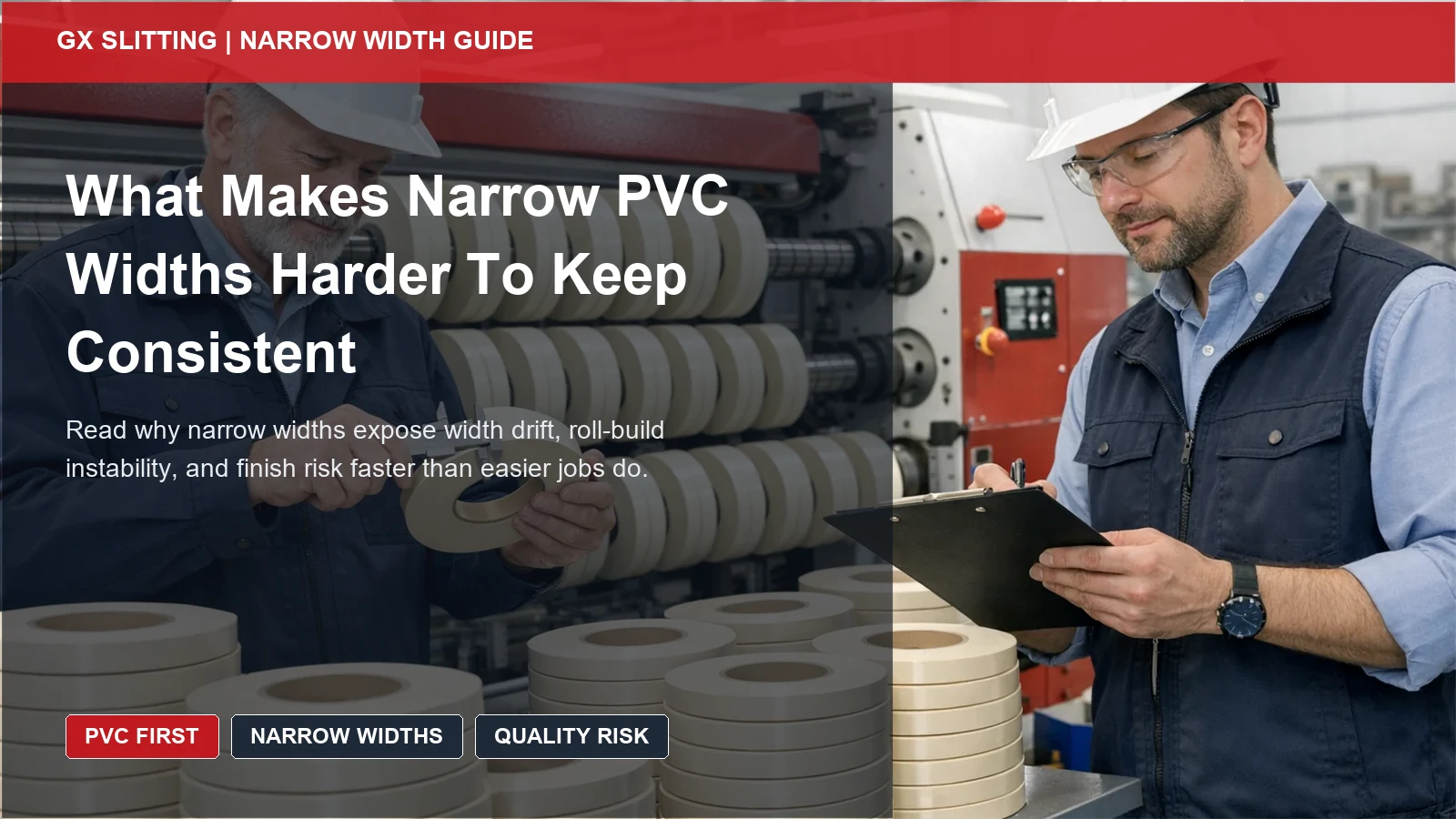
Short answer: narrow PVC widths are harder to keep consistent because they expose instability faster than easier jobs do. The narrower the finished roll, the less room there is for variation in slit pattern behavior, rewind build, handling quality, and the recovery period after changes. Buyers should therefore describe narrow-width work as a central production case when it matters commercially, not as a side note at the end of the inquiry.
If narrow widths are where the complaints really start, the supplier should hear that in the first serious conversation. Review the PVC application page, the capability page, and the RFQ guide before requesting a final machine recommendation.
1. Narrow widths reduce the room for error
At the simplest level, narrow widths are harder because the margin for visible deviation feels smaller. A broader job can sometimes absorb small instability without turning it into an immediate complaint. Narrow finished widths often cannot. Small changes in width stability, roll build, or handling consistency become easier to notice and harder to excuse in downstream use.
This is not just a psychological issue. The production case is genuinely less forgiving. Narrow-width work often puts more pressure on the line’s ability to return the same result repeatedly, especially when the plant changes patterns often or when the finished rolls must look and handle consistently in later operations.
That is why experienced buyers often describe narrow widths as the place where a line reveals itself. They are not saying the machine cannot cut them. They are saying those widths show whether the machine can hold the commercial quality boundary the plant actually needs.
2. Width consistency and roll-build consistency often get mixed together
When buyers talk about narrow-width problems, they sometimes speak as if the issue is only slit width. In practice, narrow-width difficulty often includes more than that. Width consistency matters, but finished roll build matters too. A line can technically slit to the target width and still leave the plant with narrow finished rolls that do not build or present consistently enough for downstream work.
This matters because suppliers need to know what the complaint really is. If the plant is unhappy mainly because width drifts, the conversation should focus there. If the deeper issue is that narrow finished rolls become unstable, loose, or visibly inconsistent, the supplier needs to read the job through that lens instead of treating it as only a cutting question.
Good buyers separate the two when they can. Better still, they explain how the two interact in the actual project. That makes machine discussion more useful and avoids a lot of vague talk around “precision” that never quite names the real problem.
3. Narrow widths are often where the real commercial pressure sits
Some factories make the mistake of talking about narrow widths as if they are rare edge cases, even though those widths may be central to the orders that matter most commercially. That creates a mismatch between the inquiry and the reality of the business. The supplier hears a broad PVC project and assumes the narrow widths are occasional. The plant actually depends on them far more than the RFQ suggests.
When that happens, the quotation may be built around a softer case than the one the factory lives with. The buyer then receives a recommendation that sounds acceptable but still feels vaguely wrong because it does not speak to the part of the work that really creates pressure.
The fix is straightforward: if narrow widths matter to the business, say so plainly. Do not leave them buried in a long width list. Identify them as the widths that drive complaints, margin, or buyer attention inside the plant. That immediately improves supplier understanding.
4. Changeover pressure makes narrow-width consistency harder
Narrow widths are often hardest not in isolation, but in schedule reality. A line may handle them reasonably on one stable run and then become much more fragile when moving into and out of those widths repeatedly during the day. This is where changeover rhythm enters the picture. The plant may think the issue is “narrow widths,” but the deeper issue is “narrow widths under repeated daily change.”
That distinction matters because it changes what buyers should ask. Instead of only asking whether the machine can run the width, they should ask how it behaves after moving into that width group, how quickly it returns to stable output, and whether the finished rolls remain commercially acceptable after those transitions. Those questions are much closer to the daily reality of a factory than a simple yes-or-no width question.
In many replacement projects, this is exactly where the old line has taught the plant its hardest lesson. The line can run the width in theory, but not in a way the schedule can rely on confidently.

5. Finish sensitivity raises the cost of narrow-width inconsistency
Not every PVC edge banding project reacts to instability in the same way. The cost of narrow-width inconsistency rises when the finish is more visible, more complaint-sensitive, or more important in downstream presentation. In those cases, the line is not being judged only by whether it cuts. It is being judged by whether the finished narrow rolls remain commercially clean and usable after handling and rewinding.
This is one reason why some narrow-width projects feel more difficult than others even when the numbers look similar. The material and finish environment around the width can change how much instability the plant can tolerate. Suppliers need to hear that early. Otherwise they may assume the narrow width is challenging in one generic way when the real issue is how that width behaves with a specific finish expectation attached to it.
Buyers should therefore connect width data to finish sensitivity whenever it matters. That does more to clarify the project than adding another general claim about needing high quality.
Practical rule: if narrow-width complaints become commercially serious only on certain finish types, tell the supplier that directly. It is part of the real job, not a minor detail.
6. Narrow widths also expose operator dependency
Some lines appear acceptable largely because experienced operators know how to manage the difficult cases. Narrow-width work is often where this becomes obvious. The line may still run, but only when a few people are present who know how to react quickly, make the right adjustments, and recognize when the output is starting to drift away from what downstream work will accept.
Buyers should not hide this fact in a replacement or upgrade project. If narrow-width stability depends too heavily on a small number of skilled operators, that is part of the buying case. It tells the supplier that the plant is not just asking for theoretical capability. It is asking for a line that can support more repeatable normal production.
This is also useful internally. Production teams often understand operator dependency more clearly than purchasing does. Bringing that insight into the RFQ keeps the project grounded in daily factory life instead of in simplified equipment language.
7. The supplier needs to know which narrow widths matter most
Not every narrow width deserves the same weight in the quotation. Some are occasional outliers. Others are part of the real commercial core of the business. Buyers should tell the supplier which is which. If the narrowest widths are rare and acceptable to treat as special cases, say so. If they are normal business and central to plant performance, say that instead.
This distinction is important because it changes how a supplier reads the project. A line recommendation can look very different depending on whether the narrow-width difficulty sits at the commercial center or out on the operational edge. The supplier should not have to guess.
Good buyers usually communicate this through representative slit patterns, a short note on job frequency, and a plain description of where complaints or efficiency losses actually begin. That is enough to turn narrow widths from a vague category into a real buying input.
8. A broad answer to narrow-width problems is usually a weak answer
When buyers raise narrow-width consistency, weak supplier responses often become obvious. They stay broad. They promise precision, stability, or flexibility without explaining what part of the project those words are really speaking to. Stronger responses usually feel more grounded. They connect the issue to slit pattern, daily order rhythm, finished roll targets, or the specific way the plant experiences instability.
This is why buyers should listen carefully not only to what suppliers promise, but to how they frame the problem. If the supplier treats narrow widths as a simple checkbox instead of as a meaningful part of the production case, the quotation is probably still too generic.
The right goal is not to hear the most confident language. It is to hear the most coherent language. A coherent answer usually sounds more specific because it is tied to the real job the factory is trying to run.
9. How buyers should describe narrow-width instability in the RFQ
A useful RFQ does not just list narrow widths. It describes how those widths behave in the plant. Which width groups are central? What kind of inconsistency appears? Is the issue width drift, roll-build instability, finish complaints, or loss of confidence after changeovers? How often do those widths run? Are they common enough to define the machine choice, or occasional enough to be treated differently?
These are not academic questions. They shape quotation quality. A supplier can price a width range with much more confidence when they know which part of the range really matters and why. If that explanation is missing, the supplier is more likely to respond to the width range broadly and miss the business logic hiding inside it.
That is why the best RFQs for narrow-width projects often feel more specific but also more human. They sound like they were written by people who actually live with the work, not by people who copied a product category into an email.
10. A simple internal checklist for narrow-width projects
Before asking for a final recommendation, the buyer team should be able to answer:
- Which narrow widths are commercially important?
- What kind of inconsistency actually appears on those widths?
- Does the issue show up most in steady running, after changes, or both?
- Is the problem mainly width, roll build, finish, or a combination?
- How much of current success depends on one or two experienced operators?
If those answers are still vague, the machine recommendation is likely to stay broad as well. A clearer internal diagnosis almost always produces a more useful supplier discussion.
Another useful internal check is to compare complaint history by width group instead of by project in general. Many teams remember that a line has “narrow-width problems” but have never separated which width families create the real cost and which only create occasional irritation. That distinction is commercially important because it tells the supplier where the recommendation must be strongest.
11. Turn narrow-width problems into clear purchase requirements
When narrow-width problems drive a machine purchase, describe how often the affected widths run, what defect appears, and how it affects usable output. Ask the supplier to explain how the proposed configuration addresses those conditions and what information or samples are needed to assess fit.
Ask each supplier to review the same representative slit patterns and finished roll requirements. This makes it easier to compare how the proposed knife arrangement, tension control, and rewinding setup address your narrow-width production needs.
Keep the discussion tied to your production data: width list, thickness range, roll sizes, defect photos, and order frequency. Use the same information when comparing supplier recommendations.
12. Good machine selection starts where the plant actually struggles
Factories often spend too much time talking around the difficult part of the job because they assume it is too detailed, too technical, or too messy to explain early. Narrow-width work is exactly where that instinct hurts the project. If that is where the line becomes commercially unreliable, then that is where the RFQ should become more honest and more precise.
Good buyers do not let the hardest part of the work disappear into a broad width range. They bring it into the center of the supplier conversation. That makes the quotation more relevant, the comparison more truthful, and the final decision less likely to be based on an easier version of factory reality than the one the plant actually faces.
That is the real point of talking seriously about narrow widths. It is not to make the project sound difficult. It is to make the quotation respond to the work that truly decides whether the line is good enough.
When that thinking is reflected in the RFQ, supplier replies become easier to judge. The stronger replies usually connect narrow-width stability back to actual order mix, finished roll expectations, and where the present line loses confidence. Weaker replies tend to stay broad and reassuring. That difference is often visible before any final negotiation starts.
FAQ
Why are narrow PVC widths harder to keep consistent?
Because they expose instability faster. There is less room for variation in width behavior, roll build, and handling quality before the output starts causing visible or commercial problems.
Is narrow-width inconsistency always a width problem?
No. It may also involve finished roll build, finish sensitivity, and how the line behaves after setup changes. Buyers should describe the real complaint, not assume it is only a cutting issue.
Should narrow widths always dominate the machine choice?
Only if they are central to the business or central to the complaints driving the project. Buyers should tell suppliers whether narrow-width work is a core case or an occasional edge case.
What should buyers send when narrow widths are the main concern?
Send representative slit patterns, note which narrow widths matter most, explain the type of inconsistency that appears, and connect those widths to the real project goal or complaint.
If narrow widths are where confidence breaks down, they should be at the center of the RFQ, not hidden at the edge of it.
Review the PVC application page Prepare the RFQ Ask for a Quick Quote