Skip to content Skip to content
Many PVC edge banding inquiries start with a sentence, a width list, and maybe one photo. That is enough to open a conversation, but it is usually not enough to move the supplier into a useful machine recommendation. In practical buying work, the sample often carries more meaning than the first email. It tells the supplier what the material really looks like, what the surface is like, how the job has been handled, and whether the project is being driven by a normal production case or by a narrow problem that only appears in certain orders.
Short answer: the best PVC edge banding sample set is not the prettiest sample set. It is the one that honestly represents the real production case. Buyers should send samples that reflect the normal material, the common width mix, the finish sensitivity, and the defect or quality problem that is driving the project. A representative sample helps the supplier ask better questions, scope the machine more realistically, and avoid quoting against a simplified version of the job.
If your team is about to request a quotation, prepare the samples and the RFQ together. Use the RFQ guide, compare with the PVC application page, and check the PVC machine page before sending a mixed message to the supplier.
1. Why sample quality matters before the quotation, not after it
Some buyers treat samples as something to send later, after the first price comes back. That can work if the project is very standard and the material story is simple. In PVC edge banding work, that is often not the case. The sample helps the supplier understand whether the material is straightforward, whether the finish is more sensitive than the width list suggests, and whether the project is a broad capacity request or a narrow correction to an existing production problem.
This matters because a quotation is never just a number. It is a reading of the job. If the supplier reads the job from a vague email and one width, the quote will usually be broad. If the supplier reads the job from a representative sample, a usable slit pattern, and a short note about what the plant actually needs, the quote gets more disciplined. That does not guarantee the lowest number. It does make the number more honest.
Buyers sometimes worry that sending samples early slows the process. The opposite is often true. A poor first quote creates extra loops, extra explanation, and the familiar situation where everyone thinks they are talking about the same project but nobody really is. A good sample shortens those loops because it gives the conversation something real to stand on.
2. Send samples that represent normal production, not the easiest case
The biggest sample mistake is simple: the buyer sends whatever is nearest at hand instead of what best represents the job. That often means one clean piece from an easy order, one leftover strip with no clear labeling, or one finished roll that looks acceptable but does not come from the width group that creates the most real pressure in production. For quotation and machine-matching work, those samples are often misleading.
The supplier does not need a museum piece. The supplier needs a sample that reflects what the line is truly expected to run. If the monthly mix includes narrow widths that create roll-build complaints, send one of those. If the real challenge is a more visible finish that marks easily, send that. If one common construction behaves differently from the rest of the family, include it. The point is not to dramatize the project. The point is to stop making it look easier than it is.
In practice, most buyers do better when they ask production one plain question before choosing the sample: which material or width group best represents the daily pressure behind this project? That answer usually gives you a better sample than simply asking someone to pick the cleanest roll from nearby stock.
3. One sample is rarely enough
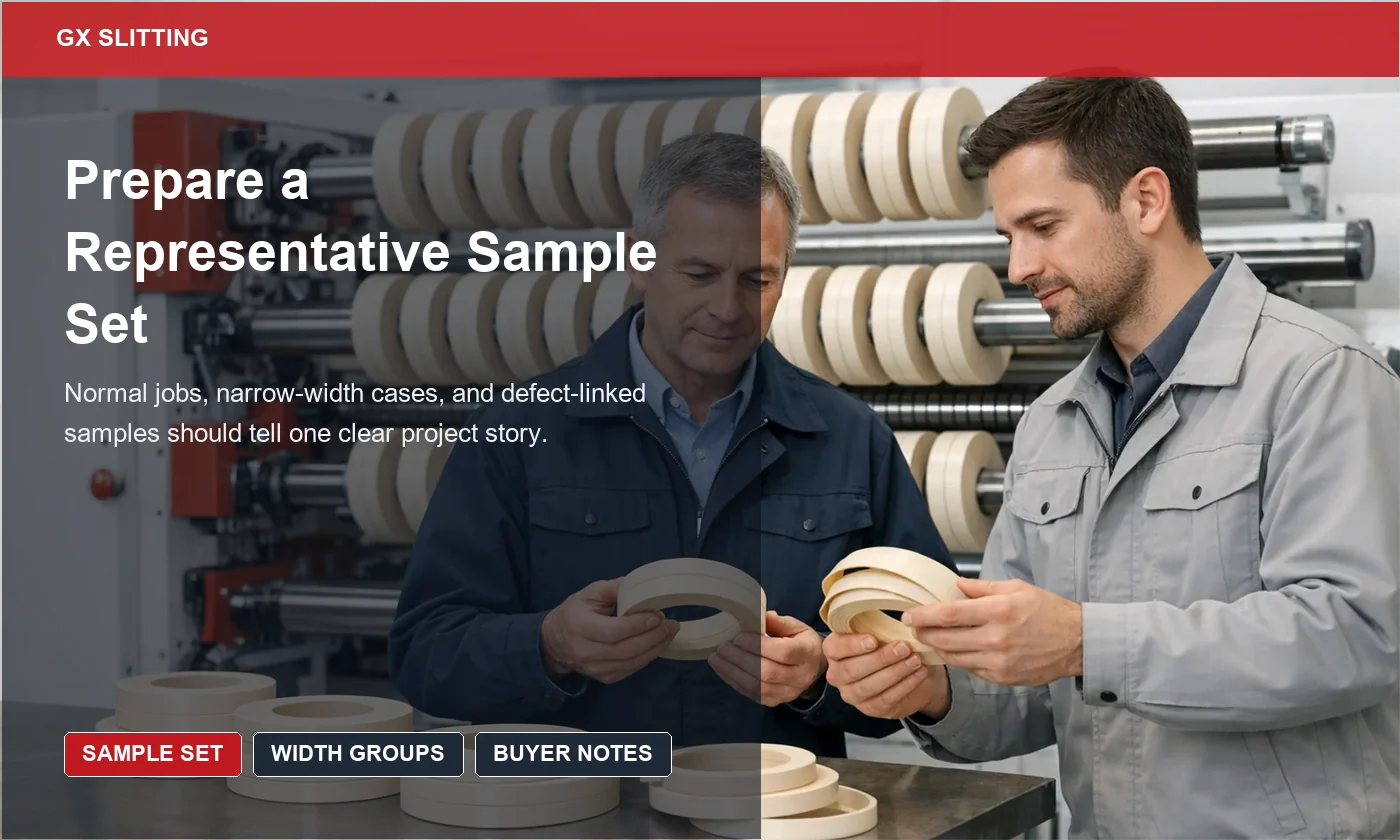
Factories often ask whether they should send one sample or several. If the job is very stable, one may be enough to start. For most PVC edge banding projects, two to four carefully chosen samples are more useful. That small set lets the supplier compare the normal case, the narrower or more sensitive case, and the sample that best represents the complaint or production bottleneck.
A useful sample set might include:
- one sample that reflects the most common production job
- one sample from the narrow-width group that creates the most daily sensitivity
- one sample linked to the defect or complaint that is driving the RFQ
- one sample from a finish or thickness case that tends to behave differently from the rest
This is enough for a practical supplier discussion without turning the RFQ into a logistics exercise. What matters is not the number of pieces. What matters is that each one has a reason for being there and that reason is stated clearly.
4. Label the sample like a buyer, not like a warehouse clerk
Many samples arrive with minimal labeling: maybe a size note, maybe an internal code, and sometimes nothing more than tape and handwriting. That is understandable inside a factory that already knows the job. It is less useful when the sample is being used to support a buying decision. The supplier needs to know what the sample is meant to show, not just what it is called in your internal system.
A useful sample label should include:
- material type or construction
- thickness range or nominal thickness
- whether the finish is visible or complaint-sensitive
- finished width or intended slit width group
- whether the sample represents a common job, a narrow-width job, or a defect-linked job
- the short reason it matters to the project
That last point is the one buyers most often skip. A note like “normal monthly volume,” “narrow-width complaint case,” or “replacement project driven by roll-build instability” can change the quality of the supplier’s response more than another generic specification line. It tells the supplier what to pay attention to.
5. Connect the sample to the slit pattern, not just to one width
A sample without slit pattern context can still help, but it leaves too much room for interpretation. The supplier may understand the material surface while still not understanding how the material behaves across the real finished-width mix. That is why samples and slit pattern data should travel together whenever possible. One explains what the material is like; the other explains what the line is expected to do with it.
If the plant normally produces several finished widths from one mother roll, say so. If the narrowest widths are where roll-build quality becomes unstable, say so. If the sample comes from a job that is easy while the project is actually driven by a more difficult width group, say that explicitly. Otherwise the supplier may give the easy sample too much commercial weight and under-read the real job.
This is also one reason why sample review often belongs in the same internal workflow as quotation review. The sample is not an isolated technical object. It is part of the story the buyer is telling about the production case. If that story is incomplete, the machine recommendation is more likely to drift.
Useful rule: if a sample matters commercially, the supplier should also be told where that sample sits in the normal slit pattern and why that part of the width mix matters.
6. Show the problem sample, not only the acceptable sample
Buyer teams often feel more comfortable sending a clean sample than a problem sample. That is understandable. Nobody wants to make the factory look messy. But if the project is being driven by a real defect, then hiding the defect slows down the technical conversation. A supplier who only sees acceptable material may never understand what is making the plant spend money on a new line or a revised quotation.
If the project is about width variation, send a sample linked to that variation. If it is about unstable finished rolls, show the supplier what the unstable result looks like. If the issue is visible marking or finish inconsistency, send the sample that demonstrates it. A clean reference sample can still be useful, but it should not be the only thing in the box.
This does not mean the buyer has to exaggerate or present every imperfection as a disaster. It means the sample set should explain the real technical reason the inquiry exists. That gives the supplier a basis for practical judgment instead of forcing them to imagine the problem from a general sentence in the RFQ.
7. Explain whether the sample is for a new capacity project or a replacement project
The same physical sample can mean different things depending on why the factory is asking for a machine. If the project is expansion, the sample mainly helps define what the new line must run. If the project is replacement, the sample may also help explain what the old line handles badly. Buyers should tell the supplier which situation they are in, because that changes how the sample should be read.
In a replacement case, the supplier usually benefits from knowing whether the sample represents a current failure pattern. Maybe the old line produces acceptable wide widths but unstable narrow ones. Maybe the finish is fine until the line has to change patterns several times a day. Maybe the issue is not cutting at all but finished roll build. The sample can support that story if the buyer says so clearly.
Without that context, the supplier may treat the sample as just another piece of PVC material and miss the operational reason it matters. The result is often a quote that sounds competent but still does not line up well with the plant’s real decision pressure.
8. Add a short written note with the samples
The best sample packages usually include a short note. Not a long memo. Just a plain explanation of what is being sent and why. That note can often be one page or less. Its job is to remove guesswork and connect the sample pieces to the commercial decision the buyer is trying to make.
A good note usually answers five questions:
- What material or material family does each sample represent?
- Which sample is the normal case?
- Which sample represents the difficult or complaint-driven case?
- What width groups or slit patterns are tied to those samples?
- What is the plant trying to improve: output, quality, changeover rhythm, or finished-roll stability?
That short note gives the supplier a stable reading frame. It also makes it easier for internal teams to check whether purchasing and production are telling the same story. If the note feels inconsistent, the RFQ probably is too.
9. Keep the sample clean enough to read, but not so curated that it becomes fake
There is a balance here. A sample should be clean enough that the supplier can examine it meaningfully. If it is damaged in transit or badly contaminated by handling, the review becomes noisy. At the same time, buyers should not curate the sample so aggressively that it no longer represents what the factory actually runs. This is especially important if visible finish quality is part of the discussion.
A practical standard is simple: send material that is representative, readable, and honestly handled. Avoid sending scraps that have no clear origin or pieces that have been touched and repacked so many times that they tell the wrong story. Also avoid sending only perfect pieces if the project exists because the factory is struggling with stability. The supplier needs a realistic picture, not a sales display.
This is another place where the short note helps. A line or two about how the sample should be interpreted often prevents unnecessary overreaction to minor handling marks while still making the real material behavior clear.
10. Samples should be supported by basic numerical data
A sample is not a substitute for the RFQ. It is support for it. Buyers still need to send the basic numerical framework: thickness range, mother roll width, finished width range, finished roll diameter target, core size, and any recurring complaint pattern. The sample helps the supplier understand what those numbers feel like in the real plant. It does not replace them.
Some of the worst quotation delays happen when the supplier receives samples without enough written data to place them. The supplier then has to ask a second round of questions just to understand what has been sent. That is avoidable. Treat the sample as one part of the package, not the whole package.
The best buyer behavior is to send the sample and the core RFQ at the same time. That keeps the conversation moving in one direction and reduces the chance that the supplier builds the first quote on incomplete assumptions.
11. What production should check before the sample leaves the factory
Before samples are sent, production should do a short internal check. Does the sample truly represent the normal work? Does it reflect the width group or complaint that is driving the project? Is it labeled clearly enough for someone outside the plant to understand it? Does the sample package include the slit pattern or at least a note about where the sample sits in the width mix? Has the team accidentally chosen an easy case because it looks cleaner than the real pressure point?
This check matters because once the sample leaves, it becomes part of the supplier’s first interpretation of the project. If the interpretation starts wrong, quotation quality suffers. It is usually worth spending a little more time on sample choice to avoid many days of correction later.
Production managers are often the people who best understand which sample is honest and which one is convenient. Their input should be in the loop before anything is packed.
12. A practical sample checklist buyers can use
Before sending the package, confirm that you have:
- one normal representative sample
- one narrower or more sensitive sample if it matters to the project
- one complaint-linked sample if the project is defect-driven
- a short explanation note
- the matching slit pattern or width-group context
- basic RFQ data for thickness, width, roll target, and project goal
If those six items are there, the supplier usually has enough to respond like a technical partner rather than like a general catalog vendor. That is the real goal. Better sample preparation is not about ceremony. It is about getting the supplier to understand the actual plant situation fast enough to give you a recommendation worth reading.
FAQ
Should buyers send finished rolls or flat material samples?
If possible, send what best explains the project. A flat material sample helps with material and finish review. A finished roll or finished-width sample helps when the project is tied to roll-build quality or narrow-width behavior. Many projects benefit from both.
How many PVC edge banding samples are enough for a quotation?
Usually two to four representative samples are enough. One should represent the normal job, and the others should represent the sensitive, narrow-width, or complaint-driven cases that matter most to the project.
Do suppliers really need defect samples?
Yes, if the project is driven by a recurring quality problem. A clean sample alone may not explain why the factory is considering a new line or a revised machine scope.
What should be written on the sample label?
At minimum: material type, thickness, width group, whether it is a normal or difficult case, and a short note about why it matters to the inquiry.
If you want a supplier to quote the real job, send the real sample set. A neat sample is fine. A representative sample is much better.
Review the flagship PVC machine Prepare the RFQ Ask for a Quick Quote