Skip to content Skip to content
Many PVC edge banding RFQs spend most of their attention on material thickness and finished widths, then treat finished roll targets as a minor specification line. In real machine-matching work, that is a weak habit. The finished roll is often where the commercial judgment becomes visible. If the supplier does not know what kind of finished roll the plant actually needs, the quotation may still arrive, but it is more likely to be broad, incomplete, or based on assumptions the buyer never meant to approve.
Short answer: buyers should send finished roll targets as a clear operating requirement, not as a last-minute detail. Tell the supplier what diameter matters, what roll-build stability is required, how the output is handled downstream, which widths are most sensitive, and whether the current line already produces loose, telescoped, or visually inconsistent rolls. That turns the finished roll from a vague expectation into a machine-scoping input.
If finished roll quality is part of the reason you are asking for a new quotation, it should be described in the first serious RFQ. Compare the RFQ guide, the PVC application page, and the PVC machine page before sending only width data.
1. Finished roll targets are not just output details
Factories sometimes talk about finished roll requirements as if they are only downstream preferences. In machine quotation work, they are much more than that. They tell the supplier how strict the rewind outcome needs to be, where the quality boundary sits, and how much everyday stability the plant expects from the line. A slitting machine is not being bought only to cut widths. It is being bought to produce output the plant can handle, store, move, and use confidently.
This is one reason broad RFQs often feel unsatisfying. The buyer may send strong material and width information, but if the finished roll target is described too loosely, the supplier still cannot read the real operating case. The quote may look technical enough, yet it still misses the part of the project that has actual complaint cost inside the factory.
Good buyers therefore treat finished roll targets as part of the central machine story. If the factory needs narrow finished rolls that remain stable, presentable, and easy to handle, that is not supporting information. That is core information.
2. Diameter alone is not a full target
One of the most common RFQ gaps is sending a finished roll diameter without describing what that diameter means operationally. Diameter matters, but it is only one piece of the requirement. A supplier still needs to know whether the roll must stay tight and uniform through handling, whether certain widths become unstable at that size, and whether the plant sees the finished roll mainly as a storage unit, a downstream feeding unit, or a visually judged product state.
When buyers send only diameter, they often assume the supplier will infer the rest. That is risky. The same diameter target can belong to very different production realities. One plant may tolerate some variation in build appearance. Another may treat that same variation as a recurring commercial complaint. The machine recommendation changes when that difference is visible.
A stronger note describes the diameter together with the stability expectation. For example: “finished rolls should hold this diameter without loose build on the narrow-width group,” or “diameter is less important than stable handling on repeated daily changes.” That gives the supplier a more useful way to read the job.
3. Roll-build quality should be described in plain language
Many buyers hesitate when they need to describe roll-build quality because they think the language has to sound highly technical. It does not. Plain factory language is usually better. If the plant cares about tightness, visual neatness, edge alignment, storage stability, or how the roll behaves when moved to the next process, say that directly. A supplier can do more with simple truthful language than with polished but empty wording.
This is especially important in PVC edge banding work because the complaint is not always width alone. The project may exist because the finished rolls look inconsistent, become loose, telescope, or demand too much operator judgment to remain acceptable. If that is the true daily pain, the supplier should hear it in the RFQ and not discover it three emails later.
Buyers should also separate what is ideal from what is required. Some plants would like perfect visual uniformity on every roll. Others mainly need handling stability and repeatability. That distinction matters. It helps suppliers understand where the line must be strongest and where the buyer is simply expressing a preference rather than a purchase-defining condition.
4. Finished roll targets should be tied to width groups
Finished roll requirements often change with width groups, but buyers do not always say so. A broader width may run acceptably while a narrower family becomes much more sensitive in build quality. A supplier who only sees one general finished roll target may not realize that the real challenge is concentrated in a smaller but commercially important part of the mix.
That is why finished roll targets should be connected to the width families that matter most. If the plant mainly struggles with loose build on narrower rolls, say that clearly. If the broader jobs are stable and the problem begins only when production enters a different width group, identify that point. Those details tell the supplier where the recommendation must be judged most carefully.
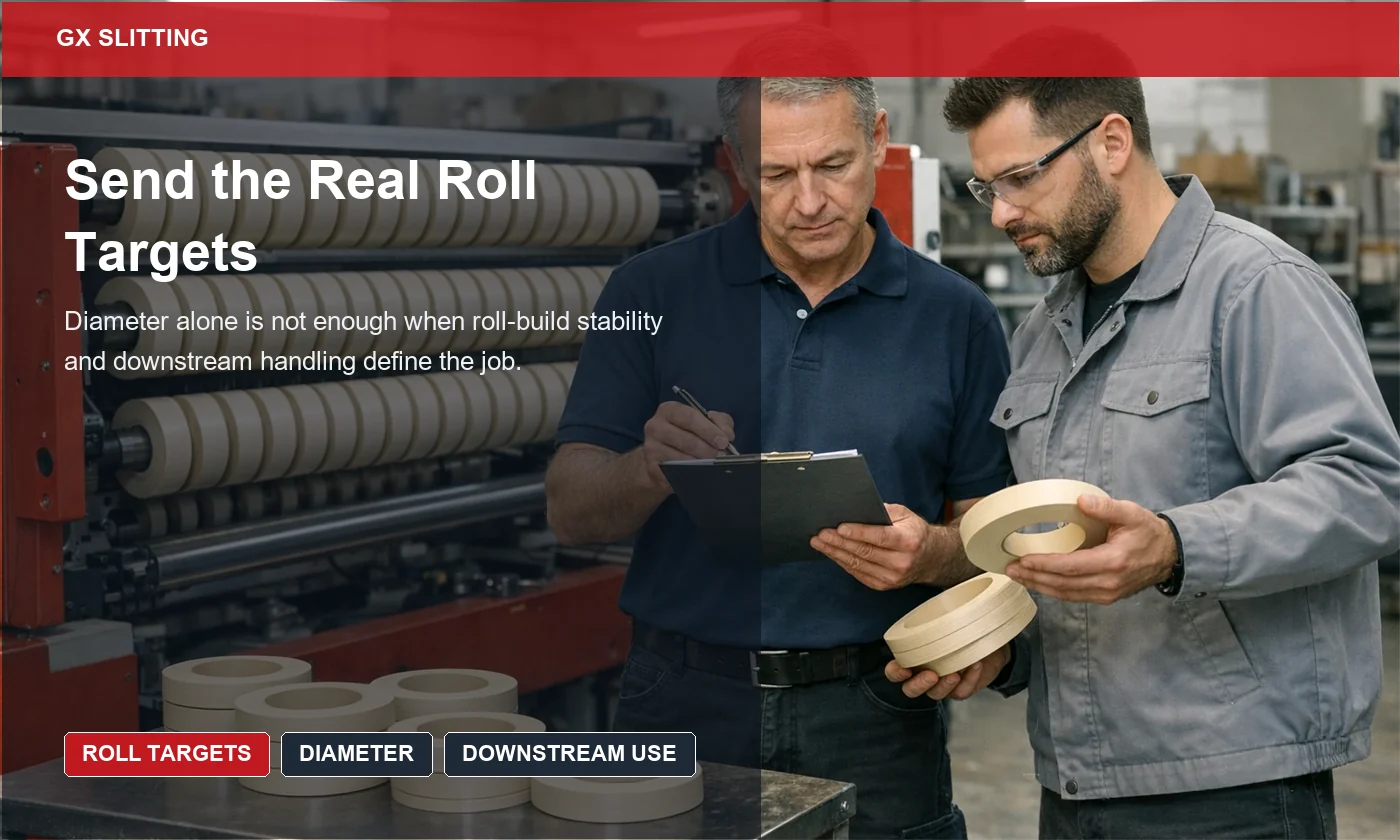
This also helps avoid misleading comparisons. If one supplier answers against the broad average and another answers against the exposed narrow-width case, their quotations may look similar on the surface while actually responding to different realities.
5. Downstream use changes how the finished roll should be described
Suppliers need to know what happens to the finished roll after it leaves the machine. Is it stored for a period? Moved often? Fed into another process that is sensitive to build quality? Judged visually by customers or internal quality teams before it ever moves downstream? These questions matter because a finished roll target is only meaningful when it is connected to what the factory actually needs that roll to survive.
For example, a finished roll that is acceptable for one plant’s storage and handling routine may be unacceptable in another plant where the next process is less forgiving. Buyers should therefore explain the practical expectation in plain terms. “Needs stable transport inside the plant” or “must feed cleanly into the next process without operator rescue” are both more useful than a silent diameter line.
This is also why some suppliers ask what seems like basic follow-up questions around roll usage. Strong buyers do not treat those questions as a distraction. They treat them as evidence that the supplier is trying to understand the real job.
Useful buyer test: if the supplier does not know how the finished roll is expected to behave after rewinding, they still do not have the full project.
6. Replacement projects should include current roll problems
When the inquiry is a replacement case, the current line already contains valuable evidence about finished roll targets. Buyers know which widths stay acceptable and which become fragile. They know whether the line tends to produce loose rolls, uneven build, or output that looks acceptable only when handled by very experienced operators. That evidence should be stated plainly in the RFQ.
Without it, the supplier may read the project as a normal capacity discussion rather than a correction of a known roll-quality weakness. The quotation then risks focusing on the wrong thing. It may speak confidently about throughput while the factory is actually spending money to remove unstable finished rolls from daily production.
One short paragraph is usually enough. “Current line loses roll-build consistency on narrow widths,” or “replacement is being driven by unstable finished rolls during repeated changes” already gives the supplier a much stronger basis for interpreting the project.
7. Samples and photos can clarify roll targets quickly
Some buyers describe finished roll quality well in words. Many do better when they support the note with a representative sample or a few clear photos. That is especially useful when the issue is visual consistency, loose build, or a difference between acceptable and unacceptable presentation that the supplier can understand quickly from what they see.
Photos should not replace written targets, but they can shorten the explanation. A photo of the current acceptable roll next to the complaint case often tells the supplier more than a long vague paragraph. The same is true for representative samples. If one roll reflects the normal outcome and another shows the real problem, send both and say what each one represents.
This is where finished roll targets become more than numbers. They become visible operating expectations. Strong quotations usually come from that combination: written targets, real width context, and visual evidence of what the factory is trying to preserve or correct.
8. Purchasing and production should agree on what “acceptable” means
Many quotation problems start inside the buyer team. Production may know exactly what finished rolls are causing trouble. Purchasing may only know that suppliers need a diameter and a core size. Quality may be focused on visual consistency. If those views are not aligned before the RFQ is sent, the supplier becomes the first place where the internal disagreement appears.
A useful internal discipline is to define acceptable output in one short shared statement. For example: “these narrow-width finished rolls must remain stable enough for downstream handling without operator rescue,” or “visual inconsistency on this finish family is not commercially acceptable.” That helps the team send one coherent message instead of three partial ones.
Suppliers answer more effectively when the buyer side sounds like one factory, not three departments speaking separately.
9. Do not let the easiest roll case define the RFQ
Factories often make the project look easier than it is by describing finished roll targets through the broadest or most stable job in the range. That may feel orderly, but it weakens the RFQ if the real complaint begins elsewhere. The easier case may be numerically representative while still not being commercially decisive.
Buyers should ask which finished roll case actually drives the inquiry. Is it the narrowest width family? The finish-sensitive jobs? The repeated changeover cases? The downstream feeding problems? Once that case is identified, the RFQ should make it visible. The project should not be quoted against a softer version of the work than the factory is actually paying to solve.
This is not about exaggerating difficulty. It is about putting the right finished roll requirement at the center of the supplier conversation.
10. What buyers should include in a finished-roll target note
A short finished-roll target note should usually include:
- finished roll diameter target or range
- core information when relevant
- which width groups are most sensitive
- what stable roll build means in the plant
- what happens to the roll downstream
- whether the current line already produces a known complaint pattern
This is enough to remove a large part of quotation guesswork. It also makes the supplier’s follow-up questions easier to judge. Good questions will usually stay connected to these operating conditions. Weak questions often drift away from them.
11. A checklist before asking for the quotation
Before the RFQ goes out, the team should be able to answer:
- Which finished rolls matter most commercially?
- What kind of roll-build result is actually required?
- Which widths or finish families expose the greatest instability?
- Have we shown the supplier what unacceptable output looks like?
- Have we explained downstream handling instead of sending diameter alone?
If those answers are still unclear, the supplier is likely to quote a broader and safer case than the one the factory really cares about. A stronger internal answer usually leads to a stronger quotation without needing more dramatic language.
12. Finished roll targets make quotations more comparable
Buyers often want faster quotations, but they usually benefit more from more comparable quotations. Finished roll targets help with that because they force the supplier to read the same output expectation the buyer is trying to buy for. When that expectation is silent, suppliers fill the gap differently, and comparison becomes noisy.
Define the finished roll before comparing quotations: target widths and diameters, core size, required winding condition, and any surface or edge defects you need to avoid. Photos of acceptable and unacceptable rolls can help explain the difference.
The strongest RFQs describe finished roll targets as part of the real machine decision. They do not hide them in the margin. They use them to define what acceptable output actually means.
Buyers also gain a second advantage when finished roll targets are described well: internal decisions become calmer. Production, quality, and purchasing can compare supplier replies against the same output expectation instead of against three different private assumptions. That reduces confusion later when one department says a quotation looks acceptable and another says it still ignores the real roll problem.
In practice, that is one of the best reasons to document finished roll targets early. It does not only help the supplier. It helps the buyer side keep the project coherent while quotations, samples, and commercial decisions start moving in parallel.
That coherence matters more than many buyers expect. Finished roll targets often sit right at the boundary between technical detail and commercial judgment. If they are unclear, the buyer may compare quotations that sound similar while each supplier is imagining a different rewind result. When they are stated clearly, comparison becomes more disciplined because the expected output has a visible boundary.
In other words, finished roll targets are not paperwork. They are one of the few places where the buyer can force a quotation to stay tied to the output the factory actually needs to live with every day.
FAQ
What should buyers send about finished roll targets in a PVC RFQ?
Send diameter or range, width context, roll-build expectations, downstream handling needs, and any known complaint pattern from the current line.
Is finished roll diameter enough by itself?
No. Diameter needs context. Suppliers also need to know what stable build means and how the roll is expected to behave after it leaves the machine.
Why should finished roll targets be tied to width groups?
Because instability often appears more strongly on certain widths. A general roll target can hide the real part of the production mix that drives the project.
How can buyers make finished roll targets easier for suppliers to understand?
Use plain language, representative samples or photos, and a short note that explains what acceptable and unacceptable output look like in the plant.
If finished roll quality is part of the buying decision, it should be part of the first serious project description.
Review the RFQ guide Check the finished roll guide Ask for a Quick Quote