Skip to content Skip to content
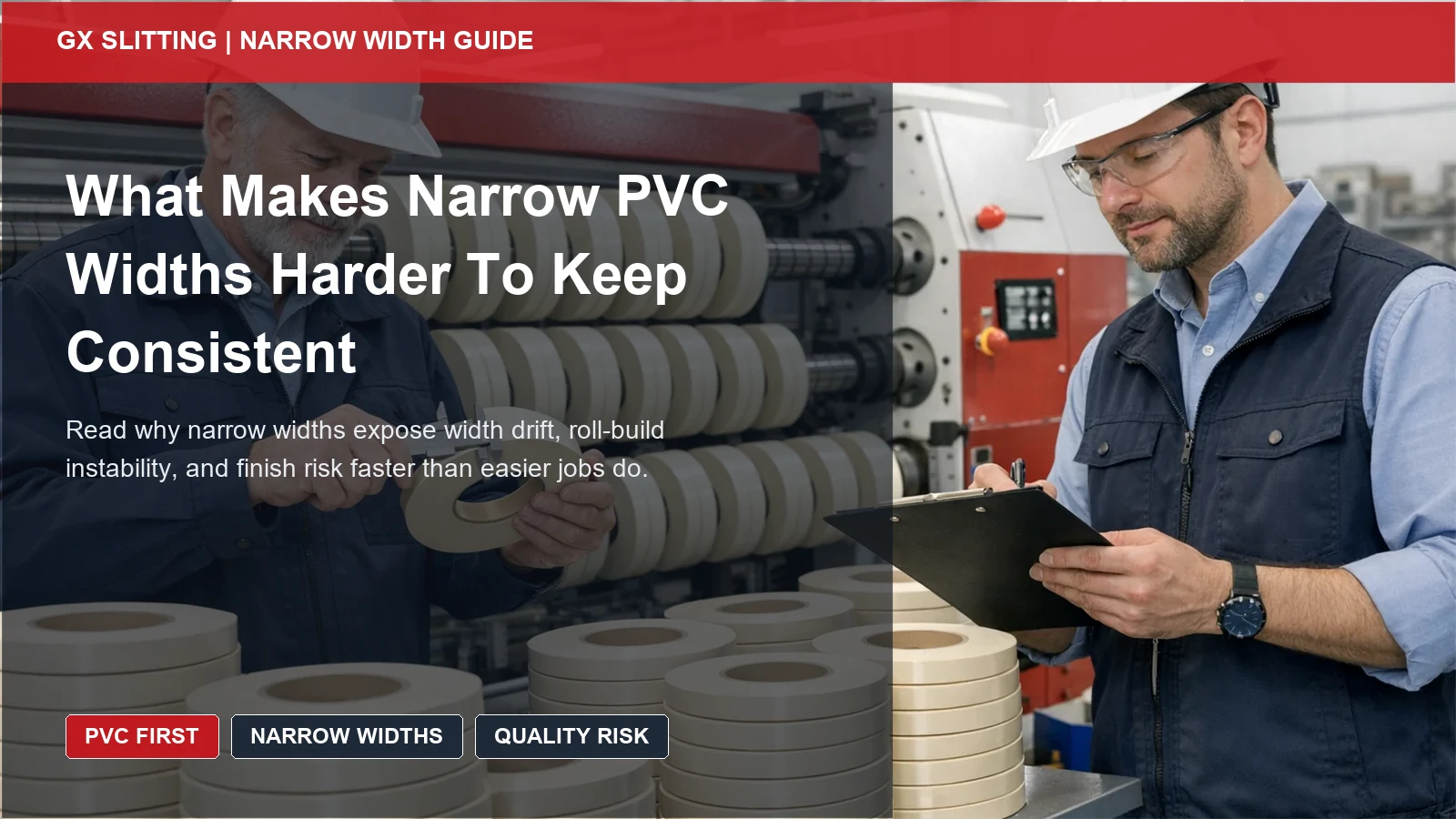
Some PVC edge banding lines look acceptable until the finished widths get smaller. That is when buyers start hearing the same complaints again and again: the rolls do not build as well, the finished result looks less stable, operators lose confidence, and downstream handling becomes more sensitive. It is tempting to describe this as a general machine-quality problem, but that usually does not go far enough. Narrow-width behavior deserves its own discussion because the commercial pain often shows up there first.
Short answer: finished roll quality often changes in narrow PVC widths because the production case becomes less forgiving. The narrower end of the width mix can expose instability in the way the job is structured, how repeatable the setup is, how the line behaves through changeover, and how well the line holds the real finished-roll target under daily production conditions. Buyers get better machine guidance when they describe those narrow-width cases separately instead of hiding them inside a general quality complaint.
If narrow widths are where your plant loses confidence, say that clearly in the RFQ. A quote built only around broad comfortable jobs will not tell you enough.
1. Why narrow widths feel different in production
Production teams do not complain about narrow widths just because they are smaller. They complain because smaller widths often show less tolerance for inconsistency. A line that feels manageable on easier jobs may start to look unpredictable when the finished rolls are narrower, the visual quality standard is high, and the roll-build target matters commercially. In that situation, narrow widths become a stress test for the whole production case.
This is why buyers should not describe the issue only as “quality gets worse on small sizes.” That statement is true but incomplete. The supplier needs to know whether the complaint is primarily about roll build, visible finish condition, stability between finished rolls, or the way the next job behaves after changeover. Narrow widths matter because they reveal which part of the process becomes fragile under tighter conditions.
When the plant is evaluating a new line, those narrow-width jobs should be treated as commercially central if they are part of the real business, not as minor side notes.
2. Narrow-width finished roll quality is not only about the knife area
One of the most common mistakes is to treat every narrow-width complaint as if it begins and ends with the cutting point. The knife area matters, but buyers usually get a better discussion when they remember that the commercial complaint often appears in the finished roll. Loose rolls, uneven build, telescoping, or unstable appearance can all be more visible at narrower widths, even if the conversation starts by talking about slitting.
That is why finished roll quality should be described in the buyer’s own language. What exactly changes when widths get smaller? Do the rolls feel softer? Do they build less evenly? Do downstream people complain about handling? Do visible quality differences appear between jobs that should look similar? Those observations help suppliers understand whether the narrow-width issue is being experienced as a pure cut-quality issue or as a broader finished-roll quality issue.
From a buying point of view, that difference matters because it changes where the quotation discussion should focus. A supplier who hears only “small widths are difficult” does not hear the whole commercial problem.
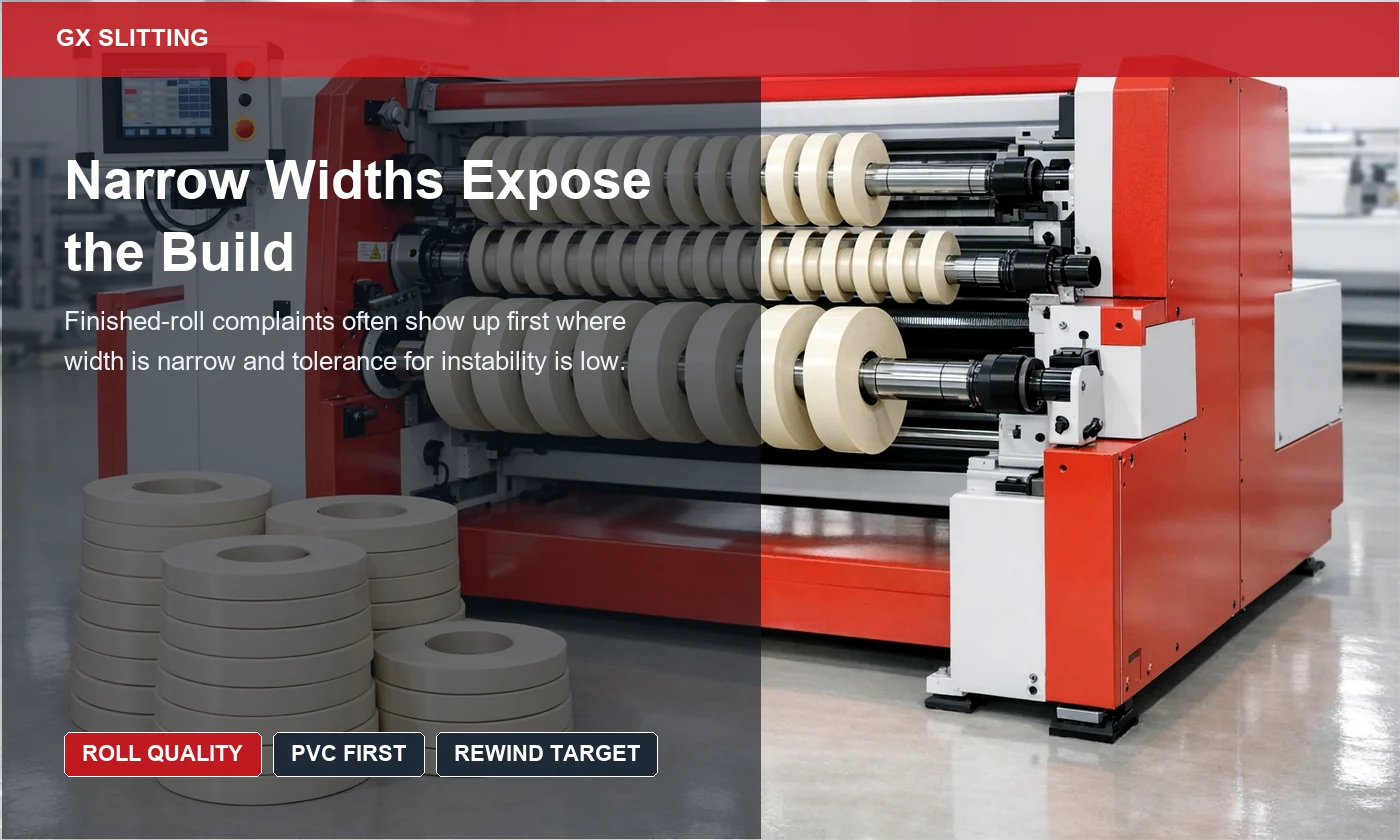
3. The width mix matters more than the single narrowest size
Buyers often send the smallest finished width because it feels like the clearest evidence of difficulty. The problem is that one number alone does not show how the plant actually runs. A line that occasionally produces a very narrow width is not the same as a line that spends much of its time on multiple narrow finished widths. The second case is more commercially important and usually deserves more weight in the quotation conversation.
That is why the narrow-width complaint should be shown inside the real slit pattern mix. Suppliers need to know whether the narrow widths are core business, whether they appear with frequent changes between patterns, and whether the plant can tolerate some instability or needs much tighter consistency. The smallest width is part of the story, but it is not the whole story.
A buyer who sends the full context usually receives better questions in return. A buyer who sends only the most difficult width often gets a quote that is either over-cautious or too generic, because the supplier cannot see how that width fits into the commercial reality of the plant.
4. Why changeover makes narrow-width quality harder
In a lot of plants, narrow-width quality is not worst in the middle of a long stable run. It is worst when the line is moving between jobs. This is one reason production teams often talk about narrow widths with frustration rather than with clean technical language. The problem may not be the width by itself. The problem may be the way the day is structured around many shifts in pattern, SKU, or setup.
Buyers should therefore say whether narrow-width quality is a steady-state problem or whether it appears mainly after changeover. This distinction changes how the project should be evaluated. If the problem lives mostly in transitions, the quote should not be judged only by catalog performance. It should be judged by whether the line is realistic for the way the plant actually works.
That one detail often improves the whole buying conversation. It helps the supplier move from a broad technical answer to a response that reflects workflow pressure as well as material behavior.
5. Finish sensitivity becomes more visible on smaller widths
For PVC edge banding, narrow-width quality complaints are often more serious when the finished product has a visible or complaint-sensitive finish. A plant may accept a certain level of minor inconsistency on a less exposed product while having much less tolerance when the downstream customer will see and judge the result immediately. Narrow widths can amplify that commercial pressure because any instability feels more obvious and less saleable.
That is why buyers should explain not only the width, but also the finish context. If narrow-width complaints are especially serious on one finish family, the supplier needs to hear that. It does not automatically mean special engineering is required, but it does mean the quote should be read through the lens of actual quality exposure rather than only mechanical possibility.
Describe the narrow-width problem with the actual width group, material thickness, roll dimensions, and operating conditions. Include photos showing how the finished rolls differ from your acceptance target.
6. What buyers should send when narrow widths are the pain point
If narrow widths are where the project becomes commercially difficult, the RFQ should reflect that directly. Buyers should include the common narrow-width patterns, the finished roll target, the kind of complaint that appears, and whether the issue shows up mainly in one finish, one thickness range, or one part of the daily workflow. Photos of finished rolls can also help if the problem is more visible than easy to describe.
This is more useful than simply saying “we need better quality at small widths.” A good supplier can do more with specifics: which widths, what kind of roll instability, and when it appears. Those details tell the supplier whether the project is being driven by narrow-width centrality, changeover weakness, finish sensitivity, or some combination of those things.
Useful buyer package: narrow-width slit pattern, finished roll diameter target, photos of unstable finished rolls, and one line on whether the issue is constant or changeover-related.
7. How to compare supplier answers when narrow widths are central
Once the narrow-width issue is clearly described, buyers should compare not only the quoted price but the quality of the response. Does the supplier recognize that narrow widths are central to the project, or do they treat them as an occasional side case? Do they ask whether the problem is tied to certain patterns or to daily changeovers? Do they speak about finished-roll stability as well as slitting? Those are the signs that the supplier is hearing the real problem.
A weak answer usually sounds broad: yes, the machine can run the material, yes, the speed is good, yes, narrow widths are possible. That is not enough if narrow-width quality is the main reason the plant is spending money. Buyers should look for reasoning, not only reassurance.
In many cases, the best supplier answer is the one that restates the buyer’s real pain point in plain language and shows how the line is being considered against that point. That is what gives commercial confidence.
8. How internal teams should talk about narrow-width complaints
In many factories, production feels the narrow-width problem first, but purchasing carries the RFQ. If those two sides do not speak clearly to each other, the issue gets flattened into vague language like “small widths are difficult.” A better internal handoff is to say what changes at the narrow widths that matter commercially. Do finished rolls build less consistently? Does downstream handling become risky? Do visible finish issues become harder to accept? Does the problem mainly appear after changeover? Those are the details that turn a real pain point into a useful buying brief.
Quality teams can help here as well by naming which part of the narrow-width complaint is only annoying and which part is truly unacceptable. That distinction matters. A plant may tolerate some inconvenience if the output remains commercially sound. It will make very different decisions if the narrow-width issue is already affecting complaints, waste, or customer confidence.
When these internal views are aligned early, suppliers receive a cleaner description and the quote discussion becomes much more practical.
9. When narrow-width trouble is serious enough to justify replacement or upgrade
Not every narrow-width complaint justifies a new capital decision. But some do. The complaint becomes commercially serious when it is persistent, tied to important SKUs, resistant to day-to-day workaround, and visible enough that the plant keeps paying for it through waste, slower work, or lower confidence in finished output. At that point, the issue is no longer a small operating nuisance. It has become a machine-matching problem.
Buyers do not need to dramatize the case. They just need to show that the narrow-width issue is not occasional noise. If the plant already knows which patterns, widths, or finishes create the trouble, that information belongs in the replacement or upgrade discussion from the first round.
This is also where the most useful quotes usually come from. Suppliers can only respond well to the narrow-width problem once they understand how central it is to the business case.
10. What buyers should send when narrow-width quality is the main reason for inquiry
When narrow-width quality is the real trigger for the project, the inquiry should carry that fact clearly. The buyer should send the key narrow-width patterns, the finished roll target, one or two photos or notes that show how the complaint appears, and a plain sentence explaining whether the issue is constant or tied to certain transitions in daily work. That is already enough to improve the next quotation discussion materially.
The important thing is not elegance. It is honesty. If the plant is spending money because the narrower jobs are where confidence falls apart, the supplier should know that from the first serious message.
Good supplier conversations usually begin when the buyer stops hiding the hard part of the business behind a broad material label and starts describing where the real commercial pain lives.
11. Why buyers should not let narrow-width problems stay in operator language only
Operators often describe narrow-width trouble in direct, useful, practical language. They know which jobs feel unstable and which rolls make them uneasy. That knowledge is valuable. But if it stays only at the operator level and never gets translated into RFQ language, the buying process loses one of its best sources of truth. Buyers should capture that experience and turn it into a short structured note the supplier can actually use.
That note does not need to sound technical for its own sake. It just needs to explain what changes, when it changes, and why the plant cares. Once that is done, the supplier can respond to the real narrow-width problem rather than to a generic sentence about “small rolls.”
In many replacement discussions, that translation step is exactly what makes the difference between a shallow quote and a serious one.
12. The narrow-width problem should be priced as a real business issue
Once the plant knows narrow widths are where finished-roll quality falls apart, that fact should shape the quote as a business issue, not as a side technical note. The supplier should understand that these widths are where trust in the line is being won or lost. When that is clear, the quote discussion stops orbiting around generic capability and starts responding to the part of the business that is actually at risk.
That shift in framing often matters more than one more round of generic comparison. It turns the project from a broad machine inquiry into a clear commercial decision that buyers, production teams, and suppliers can all evaluate with fewer assumptions and much better discipline.
FAQ
Why do narrow PVC widths often create more finished-roll complaints?
Because the production case becomes less forgiving. Smaller widths often expose instability in repeatability, roll build, and daily setup behavior more clearly than broader widths do.
Should I send only the narrowest width in the RFQ?
No. Send the narrow widths in the context of the real slit pattern mix and explain whether they are common commercial jobs or occasional special jobs.
Is this mainly a slitting issue or a rewind issue?
Often it is best treated as a finished-roll quality issue. Buyers should describe what changes in the actual roll result, not only in the cutting process.
Do photos help?
Yes. Narrow-width complaints are often easier to understand when the supplier can see the roll condition and not only read a short text description.
Where should I go next if narrow widths are our main problem?
Use the PVC application page, the RFQ guide, and your real slit pattern data before sending the inquiry.
Written by GX Slitting. This guide is based on the narrow-width questions that most often appear when PVC plants move from general dissatisfaction to a more serious replacement or upgrade discussion.
If narrow widths are where confidence drops, they should be at the center of the buying conversation, not hidden in the small print.
PVC application page PVC machine page Discuss the Narrow Widths