Skip to content Skip to content
Buyers often ask for a PVC edge banding slitting machine quote as if price should come back from a single product name. In practice, quotation moves that cleanly only when the job itself is cleanly defined. If the supplier does not know the real thickness window, finish sensitivity, width mix, finished roll target, and the actual reason the project exists, the quote can only be broad. That is where many price comparisons go wrong. The quote looks fast, but it is built on too many guesses.
Short answer: the price of a PVC edge banding slitting machine is usually shaped by the real production case, not by one headline size or speed number. Width mix, narrow-roll stability, finish protection, rewind targets, changeover rhythm, and how complete the RFQ is all influence the quotation. Buyers get better prices and better technical alignment when they describe the actual job instead of asking for a generic model quote.
If your project is already active, do not compare quotes in the abstract. Read the PVC machine page, the PVC application page, and the RFQ guide before asking suppliers to compete on numbers.
1. Why two PVC quotes can look similar and still mean very different things
In real buying work, two quotations can both claim to cover PVC edge banding and still be built around different assumptions. One supplier may be quoting against your actual slit pattern and finished roll target. Another may only be quoting against a simple material label and one demonstration width. On paper, both quotes can look acceptable. In operation, they can lead to very different machine scope, different confidence in output stability, and different levels of revision after the first round.
This is why experienced buyers do not read quotation only as a price sheet. They read it as a summary of what the supplier thinks the job is. If the quote reflects the real plant conditions, price comparison becomes meaningful. If the quote reflects a simplified or guessed version of the job, the number itself becomes less useful because it is attached to the wrong production case.
That is also one reason some factories feel that one supplier is always more expensive. In reality, the more expensive quote is sometimes just the quote built on more realistic assumptions. That does not automatically make it the right quote, but it does mean buyers should check whether the price gap comes from actual scope difference rather than from supplier margin alone.
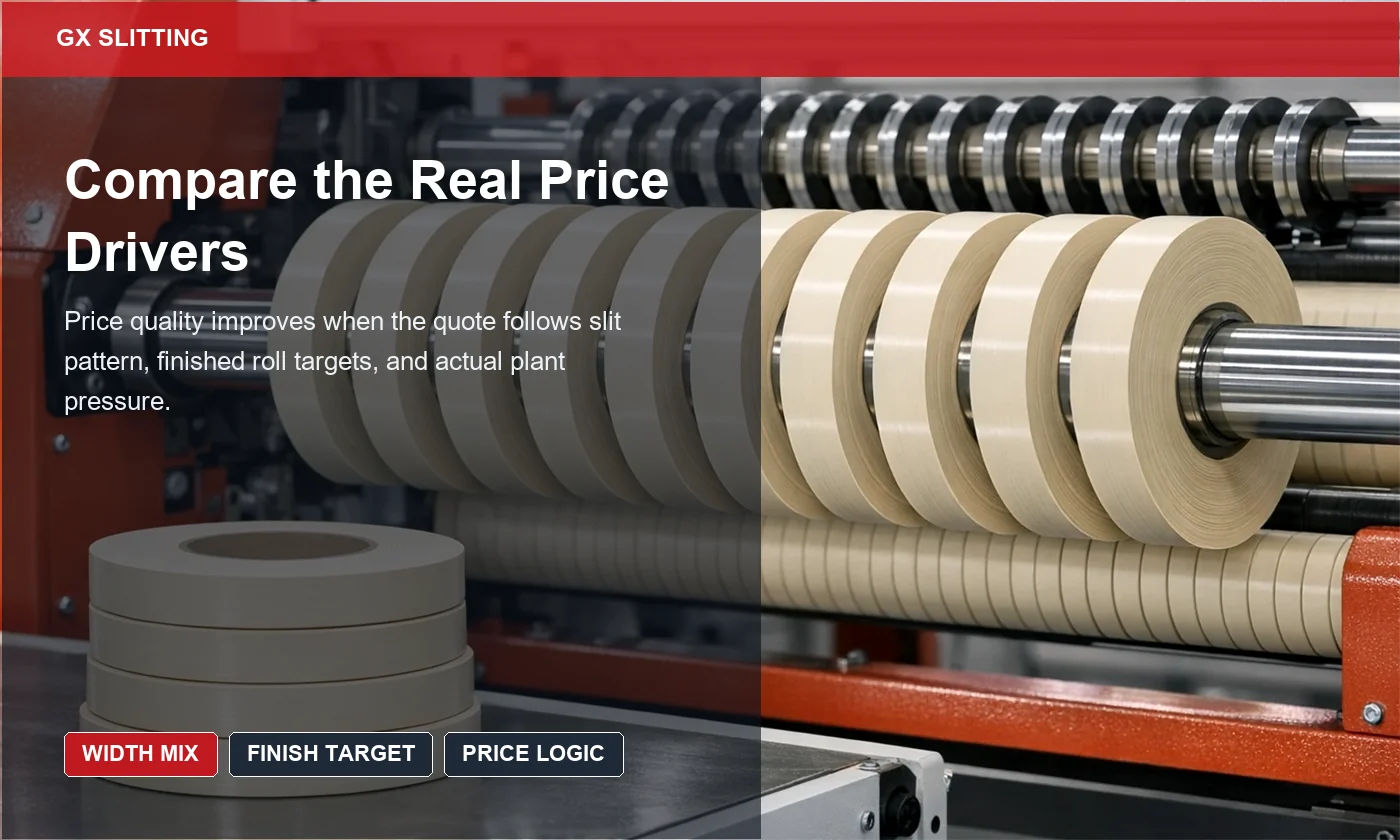
2. The first price driver is the width mix, not only the maximum width
For PVC edge banding projects, buyers often send the widest mother roll and assume that is the main quoting factor. It matters, but it is rarely the whole story. A line that covers one wide, stable, repetitive job is not the same buying case as a line that must support many narrow finished widths with frequent changes between jobs. The width mix, and especially the narrow end of the working range, usually has a major effect on how a supplier thinks about the machine.
If the project includes many narrow finished rolls, the quote will reflect more than a single maximum width value. The supplier needs to think about stable finished-roll quality, how the real slit pattern behaves, and whether the line is being matched to one representative job or to a wider monthly mix. That is why buyers should not treat “maximum width” as the main commercial variable while ignoring the rest of the width story.
In practical terms, a supplier will usually price more confidently when the buyer sends three or four common slit patterns instead of one isolated sample width. That lets the quotation respond to the real output case. It also reduces the chance that the first recommendation looks cheap only because it is matched to a simpler job than the factory really runs.
3. Thickness range and finish sensitivity change quoting confidence
Another major price driver is not the average material thickness, but the real thickness range the line must handle. A narrow, stable thickness window is easier to quote around than a broad operating window that asks the machine to stay consistent across materially different cases. The same logic applies to finish sensitivity. If the PVC has a more visible or complaint-sensitive finish, suppliers cannot treat the project as a generic roll-slitting job.
This does not mean buyers should dramatize the project. It means the quote should reflect the commercial reality of the finished rolls. A line that can technically cut the material may still be a poor fit if visible finish quality becomes unstable under the actual production routine. That is why thickness and finish information belong in the pricing conversation from the first message, not as an afterthought after the first quote arrives.
One useful way to think about this is simple: if the finished roll quality is judged by downstream people with little patience for visible inconsistency, the quote should reflect that. If the factory can tolerate a wider quality envelope in exchange for lower cost or broader flexibility, that should also be stated. Price becomes more meaningful when the supplier understands the quality standard the machine is expected to support.
4. Finished roll targets matter almost as much as the cutting itself
Many buying conversations stay focused on how the line slits PVC, but quotation is also shaped by what the finished rolls need to look like. Finished roll diameter, roll-build stability, and acceptable rewind behavior all matter. If the commercial complaint in the plant is loose rolls, telescoping, or unstable finished-roll presentation, the quote needs to respond to that. A supplier who quotes only from the “slitting” side of the job may give a number that misses the actual reason the project exists.
From the buyer side, this means finished roll targets should be explicit. It is not enough to say the line should rewind well. The inquiry should mention finished diameter, whether narrow widths are especially sensitive, and whether the current project is being driven by roll-build instability. These details do not guarantee a better price, but they usually guarantee a more honest one.
It is common to see factories compare two quotes without noticing that only one supplier has clearly engaged with the finished-roll requirement. In that case the lower quote may not really be lower for the same job. It may simply be lower because one side priced a less demanding version of the project.
5. Changeover pressure influences price more than many buyers expect
Some plants run a stable mix and measure value mainly through long-run output. Others live in constant width changes, smaller batches, and daily interruptions. For PVC edge banding, that difference matters commercially. Frequent changeovers can influence how the supplier judges the line scope, the practicality of the recommendation, and the level of confidence in daily output under real factory conditions.
Buyers sometimes say they want “high speed” when the real pressure is that the line loses too much productive time when moving between width groups. Those are not the same case. A quotation built around steady-state speed will not necessarily respond well to a plant whose real complaint is slow or unstable changes. The more clearly the buyer explains the workflow, the more likely the quote will be tied to the actual commercial pressure rather than to a generic performance line.
That is why a simple sentence about order rhythm can be valuable in an RFQ. If the factory changes widths many times a day, say so. If the plant runs larger stable batches, say that instead. Price is not produced only by hardware assumptions. It is also shaped by how the line is expected to behave in the real daily routine.
Buyer reality check: when the project is driven by narrow widths and frequent changeovers, the cheapest quote is often the one that has understood the workflow least.
6. RFQ quality changes price quality
Buyers usually ask, “What affects the quote?” One very practical answer is: the quality of the RFQ itself. Weak RFQs produce weak quotations. If the inquiry only says “please quote PVC edge banding slitting machine,” then speed, width, thickness, roll targets, defect pattern, and commercial priorities all have to be guessed. A supplier may still send a number, but the number will be broad because the job definition is broad.
Strong RFQs do not guarantee the lowest price, but they usually improve quote quality. They reduce revision, shorten clarification loops, and make it easier to compare suppliers on the same basis. That matters because buyers rarely suffer only from high price. More often, they suffer from time lost between rounds of incomplete quotation and from the confusion caused by comparing numbers that were built on different assumptions.
That is why the RFQ guide matters commercially, not only administratively. Better data usually leads to better alignment between price and real project scope. It also makes it easier to tell whether a supplier is responding to the plant’s actual case or simply sending a generic offer to keep the conversation moving.
7. Replacement projects and upgrade projects are priced differently in practice
Another factor that changes quotation is the reason for the project. Is the factory replacing a line that already exists? Is it adding capacity? Is it trying to solve one persistent quality complaint? These situations are not commercially identical. A replacement project often comes with known pain points: the current line may struggle with width drift, unstable rewind, or finish-related complaints. An expansion project may be more focused on throughput and matching the normal order mix. An upgrade project may be driven by workflow, not only by output.
Buyers should say which case they are in. Suppliers quote with more discipline when they know whether they are replacing a known problem, expanding a stable production route, or solving a narrower pain point. If the project is presented as a blank-sheet inquiry when it is actually a defect-driven replacement, the quote may stay too abstract and the supplier may miss the real reason the plant is prepared to spend money.
There is also a trust advantage here. When buyers explain the reason for the project honestly, better suppliers often respond with better questions. Those questions are useful because they reveal whether the supplier is actually matching the machine to the real case. Weak suppliers tend to react with template language and a broad price range that could fit almost any PVC inquiry.
8. How buyers should compare price without losing sight of scope
Once two or three quotes arrive, the temptation is to line up the numbers and begin negotiating immediately. That is understandable, but it is not yet the right moment if the scope assumptions are still unclear. Buyers should first ask: which quote reflects the real slit pattern? Which quote responds clearly to finish sensitivity? Which quote appears to understand whether the plant is driven by stable long runs or constant changes? Which quote engages with finished roll stability instead of only machine range?
Only after those questions are answered does price comparison become serious. Otherwise, a cheaper quote may only be cheaper because it is attached to a more generic reading of the job. That is not a pricing advantage. It is just a misunderstanding hidden inside a lower number.
In a lot of factories, the most useful pricing conversation happens after the buyer asks each supplier to restate the project in simple language. If one supplier can explain the real job more clearly, that is usually a sign that the quote has better technical grounding. Sometimes that leads to a lower final number after scope is clarified. Sometimes it confirms that one quote is more expensive because it includes things the job genuinely needs. Either way, the buyer gets a more reliable basis for decision.
9. What data to send if you want a faster and more reliable quote
If the goal is not just speed but a quote that actually matches the line, buyers should send:
- thickness range and finish type
- mother roll width and diameter
- finished slit widths and normal slit patterns
- finished roll diameter target
- core size
- whether the project is replacement, expansion, or upgrade
- the main complaint or commercial target
- photos or short notes if the current issue is visual or roll-build related
This is not overkill. It is the minimum that lets suppliers quote the real job instead of a simplified version of it. If one or two values are still open, send the current best range and say what remains under review. That is still better than waiting for a perfect RFQ while the whole project stalls.
10. How to keep a low quote from becoming an expensive project
The easiest pricing mistake to make is to compare the numbers more carefully than the assumptions behind the numbers. A low quote can be perfectly valid, but it can also be low because the supplier has priced a cleaner, simpler, or less demanding version of the job than the one the factory really runs. In PVC edge banding projects, that happens most often when narrow widths, finish sensitivity, or frequent changeovers are not described clearly enough in the RFQ.
Buyers can protect themselves with a simple habit: ask each supplier to summarize the exact production case the quotation is based on. If the summary sounds thinner than the real plant conditions, the quote is thinner than it looks. That does not automatically disqualify it, but it does mean the buyer is not yet comparing like with like.
It also helps to ask which assumption would most affect the quote if it changes. A serious supplier can usually answer that plainly. If the answer is vague, it often means the quote is still sitting too high above the real factory case.
11. What the buyer team should settle before final negotiation
Before pushing hard on price, the buyer team should settle a few internal points. Which slit patterns are truly central? Is finish quality commercially critical or just preferred? Is the project being driven by throughput, by defect reduction, or by both? Are narrow widths daily business or occasional edge cases? These are not academic questions. They shape whether pushing the quote lower will actually help the plant or just strip out scope the plant later has to buy back indirectly through lost output and daily compromise.
In a strong buying process, purchasing, production, and quality each contribute something before the final quote discussion. Purchasing clarifies the commercial frame. Production clarifies the real order rhythm and width mix. Quality clarifies what level of inconsistency is actually unacceptable. If those pieces are aligned before negotiation, the final number is much easier to read with confidence.
That is one of the places where human judgment matters more than templates. The best buyers do not just compare price sheets. They read whether the quote understands the factory.
FAQ
What is the biggest factor behind a PVC edge banding slitting machine quote?
Usually it is not one single factor. The biggest influence comes from how clearly the real production case is defined: width mix, thickness range, finish sensitivity, finished roll target, and the actual pressure behind the project.
Does a more complete RFQ usually reduce the quoted price?
Not always, but it usually improves quote quality. It reduces guesswork, lowers revision time, and makes supplier comparison more honest. In some cases it also prevents buyers from paying for the wrong scope.
Why do two suppliers quote very different prices for what sounds like the same machine?
Often because they are not quoting the same job in practical terms. One may be quoting against your actual production case, while another is quoting against a much more generic reading of the project.
Should I mention current defects when I ask for a quote?
Yes. If the project is driven by width drift, finish complaints, or unstable rewind, say so. That helps the supplier match the quote to the real commercial reason for the purchase.
Where should I start if I want a serious quote?
Start with the RFQ guide, then compare it with the PVC application page and the PVC machine page before sending the inquiry.
Written by GX Slitting. This guide is based on the pricing questions that come up most often when PVC edge banding buyers move from a broad inquiry to a serious quotation review.
If you already have the slit pattern, roll target, and the real reason for the project, send them. That is usually what turns a vague price request into a useful quote.