Skip to content Skip to content
Many PVC edge banding inquiries are slow not because the supplier is unresponsive, but because the RFQ is too thin to support a useful recommendation. A message that only says “please quote PVC edge banding slitting machine” leaves out the values that determine machine scope, knife logic, rewind setup, and the difference between a broad estimate and a technically useful quotation.
Short answer: a good PVC edge banding RFQ should include the material range, finish type, mother roll data, finished slit pattern, rewind targets, speed or output expectations, and the real defect or production problem behind the project. If buyers send that information from the start, quotation usually moves faster and with fewer revisions.
This article is for buyers preparing a real inquiry. If you are still deciding machine scope, review the PVC Edge Banding Slitting Rewinding Machine page and the PVC application page first.
1. What a good RFQ should achieve
The purpose of an RFQ is not only to ask for price. For PVC edge banding projects, a good RFQ should let the supplier understand the real converting conditions well enough to recommend the right machine direction. That includes knowing whether the project is driven by narrow-width consistency, faster SKU changes, roll-build problems, finish protection, or a more general capacity need.
If the RFQ does not explain the actual production case, quotation usually becomes slow and repetitive. The supplier asks for missing data, the buyer sends partial answers, and the first proposal often stays too general. That wastes time on both sides and increases the chance of comparing suppliers on vague assumptions rather than on the real job.
A strong RFQ should help answer four practical questions:
- What material is being slit and rewound?
- What finished rolls need to come out of the machine?
- What production pressure is driving the project?
- What machine limits or special concerns must the quotation reflect?
2. Core material data every PVC RFQ should include
Start with the basic material data, but make it real enough to reflect production rather than a generic material label. “PVC edge banding” is not enough by itself. Buyers should give the thickness range, finish type, and any surface-sensitivity notes that affect handling or finished-roll quality.
At minimum, the material section of the RFQ should include:
- PVC thickness range
- finish or surface type
- whether the material is visually sensitive or marking-sensitive
- if there are multiple material groups, which one is the main production case
If the project covers more than one PVC construction, do not compress them into one average number. Separate the main operating range from the occasional range. That helps the supplier know whether the machine should be matched to a stable core job or to a broader envelope.
3. Mother roll data and finished roll targets
After the material section, the RFQ should describe how the material enters and exits the line. This is where many inquiries stay too vague. For machine matching, the supplier needs to know what the mother roll looks like and what the finished rolls need to look like.
Include these values clearly:
- mother roll width
- mother roll diameter
- core size
- finished slit widths
- finished roll diameter target
- typical number of finished rolls from one mother roll
If the width mix changes often, attach the normal slit pattern list rather than sending only one narrow width or one wide width. For PVC edge banding projects, the slit pattern often says more about machine scope than a broad statement about the application.
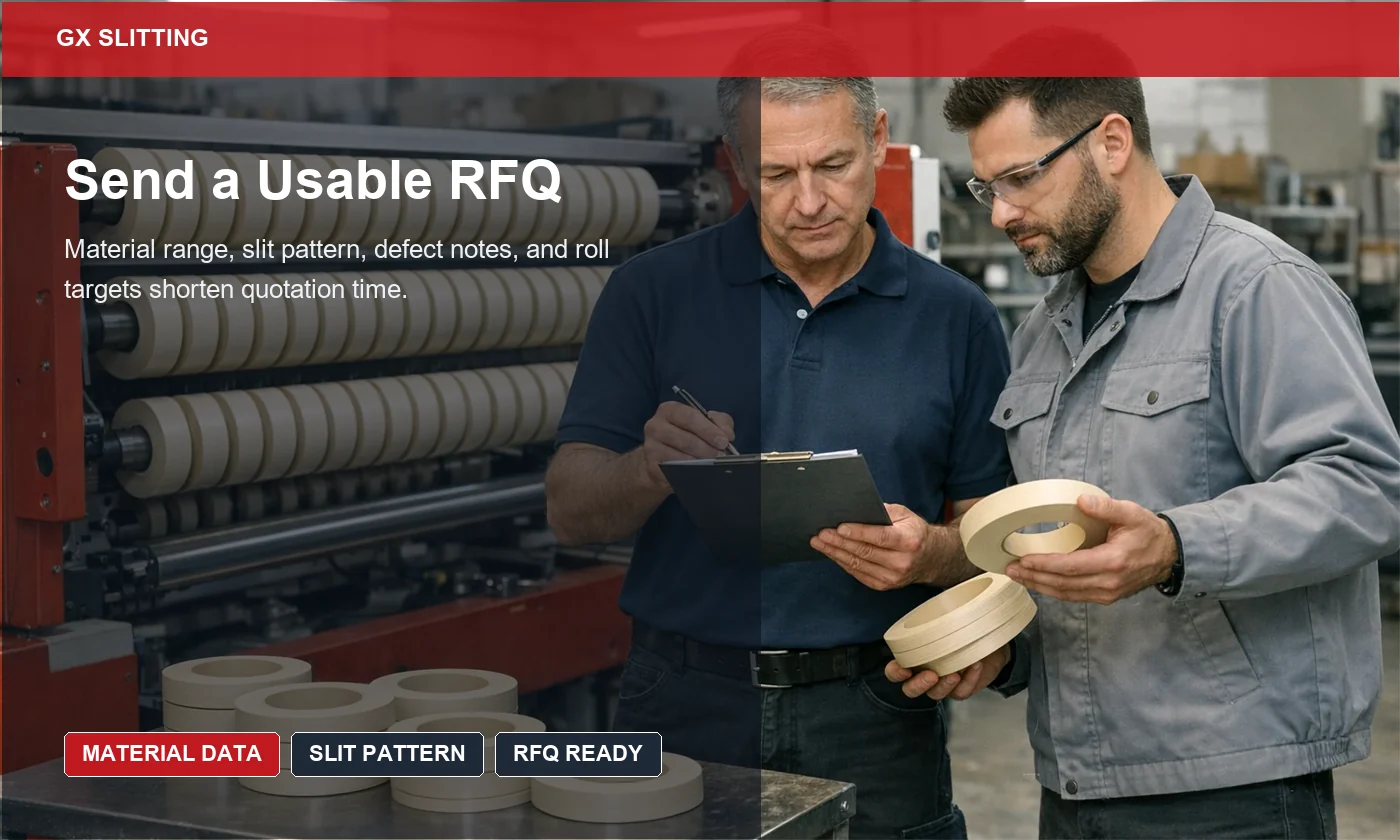
Best practice: send three to five common slit patterns if the monthly order mix changes often. That gives the supplier a better basis for judging knife setup pressure, narrow-roll stability, and changeover practicality.
Review industrial slitter rewinder machines Discuss Your RFQ
4. Output targets and real production pressure
Price and machine scope depend on more than dimensions. Buyers should also explain what the factory is trying to improve. A project driven by narrow-width quality complaints is different from one driven by faster delivery requirements or capacity expansion. The machine recommendation should reflect that difference.
The RFQ should explain:
- whether speed, quality, or broader range is the main target
- expected output or line-speed range
- changeover frequency across SKUs
- whether the project replaces an existing machine or adds a new line
- if the line must fit within a plant constraint
This matters because buyers often say “high speed” when the real issue is frequent changeover, or say “need better quality” when the real issue is unstable rewind on narrow finished rolls. A better RFQ names the actual production pressure instead of using general buying language.
5. Defects and complaints you should mention
If the RFQ is motivated by a current problem, say so directly. Many of the most useful quotation discussions begin when the buyer explains the defect, waste point, or commercial complaint that is driving the project. That gives the supplier a reason to comment on machine response instead of only quoting a general model.
Useful defect information may include:
- slit width inconsistency
- edge-quality complaints
- surface marks on decorative finish
- loose rolls or telescoping
- roll-build instability at smaller widths
- too much setup time across width changes
Do not worry that mentioning defects makes the inquiry look weak. It usually improves the quotation because it gives the supplier a concrete performance target. What hurts more is hiding the problem and then finding later that the quoted machine was never aligned with the real failure pattern.
6. Photos, samples, and attachments that speed quotation
Numbers are necessary, but visuals often shorten the quotation cycle faster than another paragraph of general description. If you already have current-line photos, finished-roll photos, or sample images that show the real slit pattern or quality problem, include them. These attachments help engineering and sales speak about the same job instead of building two different assumptions around the same inquiry.
Useful attachments include:
- photos of the current mother roll
- photos of finished rolls
- slit pattern sheet or width list
- short production video if a defect is easier to understand in motion
- photos of the current machine if the inquiry is a replacement project
Samples are especially helpful if the project is sensitive to visible finish quality or if the complaint is hard to describe in text. A supplier who can see the roll condition and the finished width mix will usually comment more precisely on machine direction.
If the inquiry is still broad, do not force a final quote yet. First compare the capability page, the PVC application page, and the RFQ guide, then send the missing details through the inquiry popup.
7. Plant and project constraints buyers often forget
Some RFQs describe the material well but ignore plant-side limits that can affect the proposal. If there are layout restrictions, power considerations, handling preferences, or workflow constraints that matter to the project, include them early. It is better to mention these at the RFQ stage than after the supplier has already built the quotation around the wrong assumptions.
Examples include:
- space limits in the intended installation area
- preferred unwind or rewind handling method
- operator workflow constraints
- required delivery timing
- whether the machine must integrate with an existing production route
Not every project needs a long technical appendix, but if one or two plant constraints materially change the buying decision, put them in the RFQ.
Who inside the buyer team should prepare each part of the RFQ
One reason RFQs stay incomplete is that the buyer expects one person to know everything. In practice, a strong PVC edge banding RFQ is usually assembled from several roles. Purchasing may own the inquiry and commercial timeline, but production usually knows the normal width mix and the real changeover pressure. Engineering often knows the technical limits, current-line behavior, and which complaints are actually caused by rewind or setup problems rather than by the knife section alone. Quality or product management may understand which surface defects or finish marks are commercially unacceptable. When these roles are not aligned, the RFQ becomes shallow and the supplier has to guess too much.
A simple division of responsibility works well. Purchasing gathers the commercial frame: project reason, delivery expectation, and any supplier-comparison requirements. Production provides the common slit patterns, finished roll targets, and the real effect of SKU changes on daily work. Engineering provides the mother roll data, known machine-side constraints, and the technical problems that the new line should reduce. Quality or product staff provide the finish-related concerns, complaint patterns, and what “acceptable roll quality” actually means for the end customer. This does not need a large internal meeting. Even a short internal checklist completed by the right people produces a much better inquiry than one person guessing through every field.
For multi-plant companies, it is especially important to identify which plant’s data is the basis of the quotation. Buyers sometimes combine dimensions and complaints from several lines into one blended RFQ. That makes machine matching weaker because the supplier is not responding to one actual production case. If the project is intended for Plant A, then Plant A’s data should lead, even if the buyer also wants to know whether the line could later be used for a broader range.
Must-have RFQ data versus good-to-have RFQ data
Not every inquiry will have complete information on day one. That is normal. What matters is knowing which data points are essential for the first usable quotation and which ones are helpful but not mandatory. This distinction keeps the project moving without lowering the quality of the inquiry too much.
Must-have data usually includes material thickness range, finish type, mother roll width, mother roll diameter, core size, finished widths, finished roll diameter target, and the main production problem or commercial target. Without those values, the quotation is often too broad to be useful.
Good-to-have data includes photos of finished rolls, current-machine photos, short production videos, notes about installation preferences, and a more detailed description of the internal workflow. These details often improve the quality of the recommendation, but the supplier can usually begin serious discussion without every optional input being complete.
When one or two must-have values are still open, the best approach is to send the current range and clearly note what is still under review. That is better than holding the whole RFQ back while every detail is polished. For example, if the finished roll diameter is still being finalized between two close targets, say so. If the monthly width mix is still being reviewed, send the current top three or five slit patterns and note that the list may be updated. That keeps the quotation process honest without forcing unnecessary delay.
How to judge the supplier response after you send the RFQ
A strong RFQ should produce a stronger supplier response. Once the inquiry has been sent, buyers should not compare replies only by speed or by whether a price appears quickly. The better test is whether the supplier has understood the production case and responded to the right pressure points. For PVC edge banding projects, a good response should reflect the material range, the normal slit pattern, the finished-roll target, and the actual reason the project exists. If the reply ignores those and falls back to general machine language, the quotation discussion is still too shallow.
Look for signs that the supplier has processed the RFQ correctly. Good signs include specific follow-up questions about the width mix, finish protection, or rewind stability; a clear distinction between standard and more application-specific scope; and a response that refers back to the defect or production target you named in the RFQ. Weak signs include recycled brochure wording, no mention of the actual slit pattern, or a quotation that looks identical to what could be sent to any roll-slitting inquiry.
This is also the stage where buyers should compare how disciplined each supplier is with missing data. A serious response does not need to pretend every unknown is already solved. It can say which points are sufficiently defined for quotation and which points still need confirmation. That kind of response usually reflects better engineering discipline than a fast but generic offer. For the buyer, the objective is not only to receive a number quickly. It is to reach a quotation that can survive technical review and lead to a machine discussion that fits the real plant conditions.
8. Common RFQ mistakes that slow quotation
- Asking for price without the slit pattern. A headline request is not enough for a useful recommendation.
- Sending only one sample width. That often hides the real monthly order mix.
- Leaving out the defect target. If the project is driven by quality complaints, the RFQ should say so.
- Combining multiple material ranges into one average value. That can distort machine matching.
- Waiting too long to share photos or samples. Visual evidence often shortens the cycle.
- Treating quotation as only a price step. For PVC edge banding, it is also a technical matching step.
9. Practical PVC edge banding RFQ template
Buyers can use the structure below when preparing the first inquiry:
- Material: PVC edge banding, thickness range, finish type, any surface-sensitivity notes.
- Mother roll: width, diameter, core size.
- Finished rolls: slit widths, target finished diameter, normal slit patterns.
- Output target: expected speed or output range.
- Production case: whether this is replacement, expansion, or new project.
- Current problem: edge issue, width drift, unstable rewind, surface marking, or slow changeover.
- Attachments: photos, sample roll images, slit pattern sheet, or current machine photos.
If that structure is used, the first quotation discussion usually becomes much more useful. The supplier can respond to the real job instead of only sending a broad machine offer.
FAQ
What is the minimum information I should send in a PVC edge banding RFQ?
At minimum, send thickness range, finish type, mother roll width and diameter, core size, finished slit widths, finished roll diameter, and the main production problem or target. Without that, the quotation usually stays too general.
Do I need to send every width we ever run?
No, but you should send the normal width groups or common slit patterns. That is usually enough to show the real monthly order mix.
Should I mention current defects in the RFQ?
Yes. If the project is driven by width inconsistency, edge issues, loose rolls, telescoping, or surface marking, that should be in the inquiry. It improves the technical value of the quotation.
Are photos and samples really necessary?
They are not mandatory for every inquiry, but they often shorten quotation and reduce misunderstanding, especially when finish quality or roll-build quality is important.
Where should I go if the project is still not clearly defined?
Start with the RFQ guide, then compare the Products, PVC application, and Capabilities pages before sending the inquiry.
Written by GX Slitting. This article is built around the information gaps that most often slow PVC edge banding quotation and machine-matching discussions.
If your team already has the width list, roll targets, and current problem summary, send them directly through the inquiry popup. That is usually the fastest path to a usable quotation.
RFQ guide PVC machine page PVC application page Send Your Specs