Skip to content Skip to content
Comparing two PVC edge banding slitting machine quotations sounds simple until the papers are actually on the table. On one quote, the number looks lower and the delivery statement sounds clean. On another, the supplier seems to be asking more questions and the number is less comfortable. Many buyer teams instinctively move toward the cheaper offer because that feels like the efficient move. In real factory work, that is often the moment when the project either becomes disciplined or starts drifting.
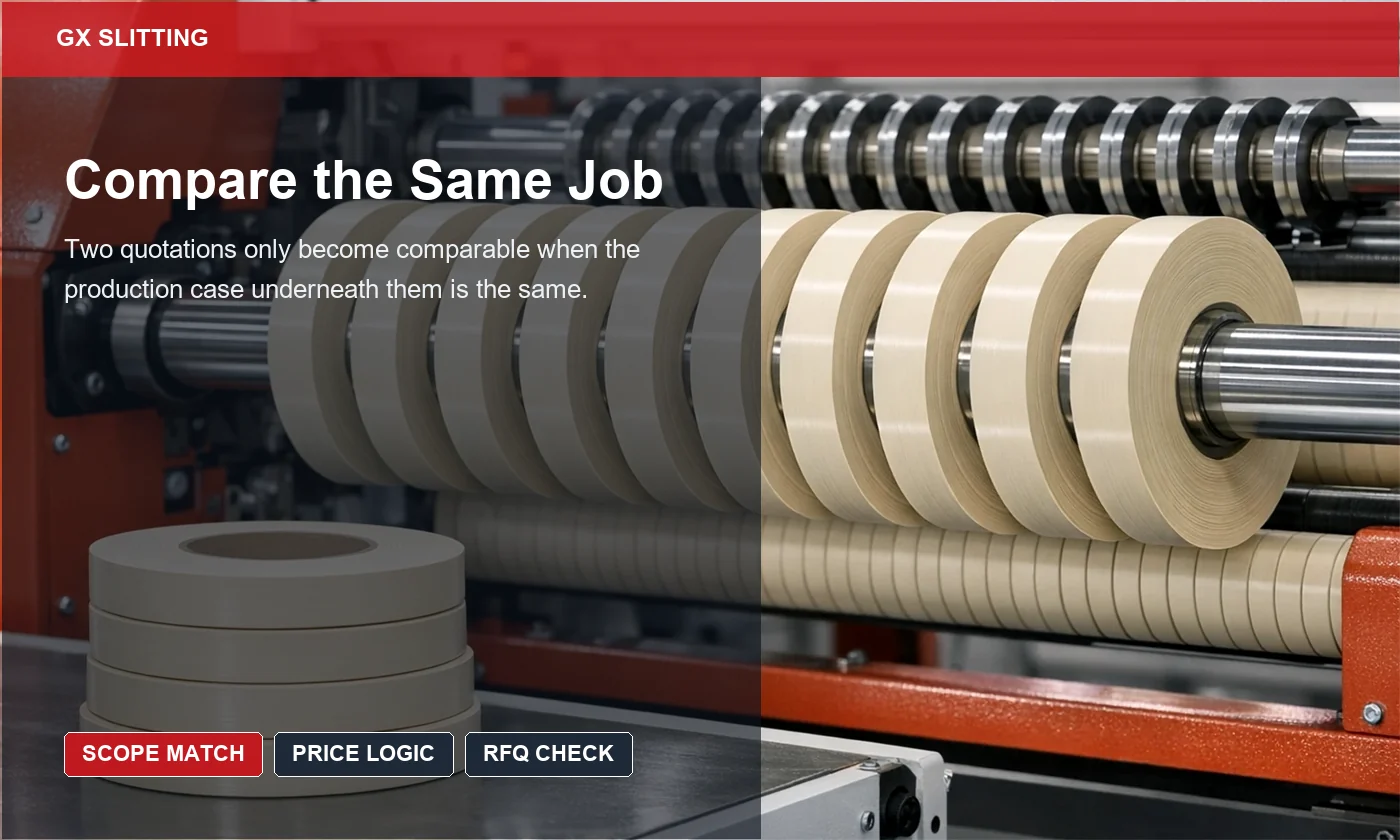
Short answer: buyers should compare two PVC edge banding slitting machine quotations by checking whether both suppliers are pricing the same production case. The number matters, but it only becomes meaningful after width mix, finish sensitivity, finished roll targets, changeover pressure, defect history, and RFQ completeness have been aligned. A lower quote built on a simpler assumption set is not truly a lower quote for the same job.
If your team is already comparing suppliers, slow the process down just enough to compare scope before price. Review the PVC machine page, the PVC application page, and the RFQ guide before locking the shortlist.
1. Start by asking whether the two quotations are really quoting the same job
The first mistake in quote comparison is assuming both suppliers have understood the same project. One supplier may have built the offer around your real slit pattern and the widths that actually consume most of the month. The other may have priced a simplified case around one representative width and a neat headline speed. Both quotations can say “PVC edge banding slitting machine,” but they may be standing on different ideas of what your line needs to do every day.
That is why a serious buyer never compares numbers first. The first comparison should be the job description behind the number. Did the supplier mention the narrow widths that create most of the pain? Did the quote reflect the finished roll diameter that matters to downstream work? Did it acknowledge whether the project is driven by quality complaints, capacity pressure, or a replacement of a line that already disappoints the plant? If those answers are different, the quotations are not yet comparable.
A lot of poor buying outcomes start with a paper comparison that ignores this point. The cheaper quote feels like progress, so the team pushes the negotiation there. A few weeks later, clarifications start coming back in. Suddenly the scope is being revised, key assumptions are being revisited, and the internal feeling is that the supplier changed the price. In many cases, the problem started earlier: the original quote was never for the real job.
2. Read the quotation as a technical summary, not just a price sheet
Every quotation tells you something about how the supplier thinks. A disciplined supplier usually reveals the project logic in the quote itself. The language may mention common slit widths, material thickness range, finish sensitivity, rewind targets, or the reason the factory is considering the machine. A generic supplier tends to rely on broad language that could fit almost any slitting inquiry. The number may look attractive, but the text around it often feels thin because the supplier has not really committed to a clear reading of the job.
This is why buyers should read quotations the way experienced production people read a process note: not only for what is included, but for what seems to have been understood. If the offer does not reflect the real production case, price comparison will be unstable from the beginning. You do not need marketing language. You need signs that the supplier has translated the RFQ into a practical machine concept.
One useful exercise is to ask each supplier to summarize the project in six or seven plain lines. Not a brochure paragraph. Just a concise statement of what they believe the line must handle. When suppliers do that, differences appear quickly. One may clearly describe the normal width mix and the pressure around narrow finished rolls. Another may fall back to generic output language. That difference matters because it often predicts which side is more likely to stay aligned through the rest of the discussion.
3. Width mix is usually more important than the single biggest width
Many quotations highlight the maximum mother roll width because it is easy to state and easy to compare. In PVC edge banding work, that can be misleading. The real difficulty often sits in the width mix. If the plant runs many narrow widths, especially in combinations that shift frequently, that changes what stable daily performance really means. A quote that looks good against a single broad number may say very little about how the machine will behave across the working mix that actually generates revenue.
When you compare two suppliers, ask what width mix each quotation is really built around. If one supplier refers to three common slit patterns and the other stays near a single demonstration case, they are not yet competing on equal ground. The supplier using the broader pattern may appear more expensive because the quote is tied to real plant behavior instead of a showroom case.
Buyers should also look for signs that the supplier understands the commercial weight of the narrow end of the work. Some factories make margin on the part of the width range that is operationally more sensitive. If the quote ignores that and prices around easier widths, the comparison can look fair while the project logic is already off target.
4. Check whether both suppliers are responding to the same quality expectation
Quotations can drift apart because the quality standard inside them is different. One supplier may assume that any roll which is technically slit and rewound is acceptable. Another may be responding to a much tighter expectation around edge consistency, width stability, finished roll presentation, and visible surface protection. That second quotation can easily look more expensive because it is tied to a tougher operating reality.
The right way to compare is not to ask which supplier promises more. The right way is to ask which supplier is speaking to the actual quality boundary in your plant. If downstream users complain quickly when roll build is unstable or when visible marks affect appearance, the quote should reflect that. If the plant can tolerate more variation in exchange for a lower budget, say that honestly. A quote comparison without a shared quality standard is a slow route to internal confusion.
This is also where buyers should be careful with vague promises. “High precision” and “good rewinding” do not mean much on their own. Better quotations usually show that the supplier has understood what “good” means in the plant that will run the line. The more concrete that understanding is, the more trustworthy the comparison becomes.
5. Delivery time only matters after you know what is being delivered
One quote often wins early favor because the delivery line looks shorter. That can be reasonable, but only if the scope behind the delivery line is stable. A fast delivery statement on a loosely defined machine is not automatically stronger than a slightly longer delivery statement on a quote that has actually digested the project. Delivery should be compared after scope clarity, not before it.
In real buying work, shorter delivery can sometimes mean the supplier is quoting from a broad standard assumption set. That may still be fine if your job is truly standard. It becomes risky when the project includes frequent width changes, more sensitive finish requirements, or a need to stabilize narrow finished rolls. Those cases benefit from clearer upfront alignment, even if the conversation takes a little longer.
That does not mean buyers should reward slow suppliers. It means they should separate real efficiency from superficial speed. A supplier who takes the time to ask the right questions may actually reduce the total project timeline by avoiding later scope revision. The supplier who rushes to send a number may win the first impression while creating more friction later.
Plain rule: a fast quote built on weak assumptions is not the same thing as a fast project.
6. Ask both suppliers what would most change the quotation
This question is simple and very revealing: what assumption, if changed, would most affect the quotation? Serious suppliers can usually answer directly. They may point to the narrow width mix, to the finished roll diameter, to surface sensitivity, or to the actual frequency of slit-pattern changes. Weak suppliers often answer in a way that sounds polished but gives you no technical handle on the project.
The value of this question is not just technical. It helps buyers understand where comparison is most fragile. If supplier A says the key variable is the narrow finished width range and supplier B says the key variable is only maximum mother roll width, that tells you a lot about how differently they see the job. It may also explain why the price gap exists.
Once you know the key assumption behind each quotation, you can test it internally. Ask production whether that assumption matches daily work. Ask quality whether the stated priority matches real complaint patterns. Ask purchasing whether the commercial risk of getting that assumption wrong is acceptable. That internal check often does more to improve a buying decision than another round of raw price negotiation.
7. Replacement projects should be compared against the current line’s failures
If the new machine is replacing an existing PVC edge banding slitting line, quotation comparison should include one more step: which supplier has truly understood why the current line is failing the plant? Sometimes the issue is width variation. Sometimes it is unstable finished-roll build. Sometimes the machine technically runs, but changeovers consume too much time and frustrate the team. A quotation that ignores the current line’s real weakness may still look acceptable on paper, but it is not aimed at the actual reason money is being spent.
Buyers should therefore compare each quotation against a short defect or pain-point list. Did the supplier address the recurring complaint, or only the generic machine category? If the supplier has not connected the new line to the old problem, the quotation is incomplete no matter how neat the price layout looks.
This is also where plant memory helps. Production managers often know which daily frustrations matter more than the formal RFQ suggests. Let that information into the quote comparison. It gives the decision more weight than simply lining up price columns and hoping the right answer will reveal itself.
8. Watch for the difference between a standard-fit quote and a custom-fit quote
Not every project needs a more customized machine scope, and not every buyer benefits from paying for one. The issue is not whether customization sounds advanced. The issue is whether the quotation is trying to solve a production case that truly needs more adaptation. If the monthly work is stable, the width range is disciplined, and quality expectations are clearly understood, a strong standard-fit quote can be exactly right. If the job mixes narrow widths, frequent pattern changes, and sensitive finish expectations, a quotation that stays too generic may be under-reading the case.
When comparing two quotations, ask what each supplier believes is standard in your project and what they consider nonstandard. The answers will tell you whether the price gap reflects a real interpretation difference or just different sales habits. One supplier may be building a safer technical scope. Another may be relying on a lighter commercial entry point and leaving harder questions for later.
The goal is not to automatically prefer the more complex quotation. The goal is to know whether the simpler quotation is simpler because the job truly allows it or because the supplier has not yet looked closely enough.
9. Do not let polished wording hide weak process thinking
Some quotations read better than others. That can create false confidence. Clean formatting, confident language, and organized tables make a good impression, but they are not proof that the supplier has thought clearly about the machine. Buyers should distinguish between presentation quality and process quality. A well-written quote can still be technically thin. A more ordinary-looking quote can still reveal sharper judgment if the assumptions inside it are closer to the real factory case.
This is where buyer discipline matters. Strip the offers back to essentials. What job does each one describe? What plant pressure does each one appear to prioritize? Which one acknowledges the narrow widths, finished roll standards, and order rhythm that define your actual business? These questions protect the team from being carried away by a slick document that is weaker than it first appears.
At the same time, do not punish a supplier for asking more questions. In industrial buying, extra questions are often a sign of better process thinking, not of uncertainty. The problem is not questioning. The problem is pretending the job is simple when it is not.
10. Compare total decision quality, not just supplier numbers
By the time the buyer team is ready to choose between two quotations, the real comparison is broader than price. Which supplier seems more likely to stay aligned when details tighten? Which one appears to understand the daily job instead of only the category name? Which quote gives the internal team more confidence when production, quality, and purchasing sit together to review the decision? Those questions belong in the commercial process because the cost of a weak selection is rarely limited to the purchase price.
In a factory environment, the wrong quote can remain expensive long after the invoice is forgotten. It shows up as avoidable back-and-forth, disappointing output, internal irritation, and the feeling that the project was decided too quickly. Strong buyers try to prevent that by making the comparison harder at the beginning and easier later. They want the documents to reflect the real job before the negotiation becomes aggressive.
That is one reason practical teams usually do better than purely price-driven teams. They allow the quotation to be a decision document, not just a number sheet.
11. A simple comparison method that works in real buying meetings
If your team needs a clean method, use five columns during the meeting: actual slit-pattern coverage, quality expectation match, finished-roll target match, workflow and changeover understanding, and price. Force the first four to be discussed before the fifth. This slows down the part of the meeting that people often try to rush, but it gives the price discussion a real technical base.
Then ask each supplier three plain questions: What is the quotation based on? What would most change the number? What daily problem is this machine primarily solving? Those answers are easier to compare than broad promotional claims, and they give nontechnical decision-makers a better way to understand the difference between the offers.
When that method is used, the team usually becomes calmer. It stops chasing the most convenient number and starts choosing the quotation that best fits the work the plant actually needs to run.
12. What to send suppliers before asking for a final revision
Before you ask either supplier for a final quotation round, send the same update set to both sides. Include the real thickness range, the main slit patterns, the narrowest important widths, the finished roll diameter target, the most common quality complaint, and whether the project is replacement or expansion. If one assumption has changed since the first RFQ, make that explicit. Do not assume the suppliers will infer it from scattered messages.
This simple step often improves quote quality immediately because it forces alignment. It also protects the buyer from creating an unfair comparison where one supplier has been fed stronger information than the other. If the final decision is going to be serious, the final quotation round should be serious too.
Many teams discover at this stage that the gap between quotations narrows once both suppliers are pricing the same production case. That is useful because it means the final choice can be made on better grounds than a misleading first-round price spread.
FAQ
Should buyers always choose the quotation with more technical detail?
Not automatically. More detail is useful only if it reflects the real production case. But when one quotation is clearly tied to actual slit patterns, finished roll targets, and known pain points, it is usually a stronger basis for comparison than a generic offer.
Why can the lower quotation still be the riskier one?
Because it may be based on a simpler assumption set than the real job requires. If narrow widths, finish sensitivity, or changeover pressure have been under-read, the quote can look cheaper only because it is pricing an easier project.
What should purchasing ask production before choosing between two suppliers?
Ask which slit patterns matter most, what quality failures create the biggest complaint burden, whether narrow widths are daily business, and what the current line does badly enough to justify replacement or upgrade.
Does delivery time matter less than price?
Neither matters in isolation. Delivery becomes meaningful only after the machine scope is clear. A shorter delivery statement built on a weaker understanding of the job is not necessarily the better commercial choice.
If you already have two quotations in hand, send the real slit pattern and complaint points before deciding. That usually tells you more than another round of headline price discussion.
Review the flagship PVC machine Check capability points Ask for a Quick Quote