Skip to content Skip to content
PVC edge banding buyers often describe a project by saying “the quality is unstable” or “the current machine does not run well,” but that is not enough to identify the real problem. In slitting and rewinding, the visible defect is often only the last signal in a longer chain of setup, tension, slit-pattern, or handling issues. If the defect is described too broadly, the next quotation can drift toward a generic machine answer instead of a useful recommendation.
Short answer: common PVC edge banding slitting defects usually fall into a few practical groups: width inconsistency, edge-quality issues, surface marking, loose or telescoping rewind, uneven roll build, and changeover-related instability. Each group points buyers toward a different set of questions about the real job, the machine direction, and the data that should be sent before asking for a quotation or technical recommendation.
This article is meant for diagnosis before quotation. If the project is already clearly defined, go straight to the PVC Edge Banding Slitting Rewinding Machine page and the RFQ guide. If the defect is still being understood, use this page to structure the discussion first.
1. Why buyers should treat defects as process signals, not just quality complaints
In PVC edge banding projects, the same visible complaint can come from different parts of the converting process. A finished roll that looks unstable may point toward rewind behavior, but it may also be related to slit-pattern pressure, width mix, or the way the job changes from one SKU to another. A surface-quality complaint may look like a knife issue but can also come from handling or tension behavior. That is why buyers should resist the urge to reduce every complaint to “the blades are bad” or “the machine quality is poor.”
A more useful approach is to ask what the defect actually looks like, when it appears, how often it appears, and whether it is tied to specific widths, thicknesses, finishes, or order-change situations. This moves the discussion from complaint language to diagnostic language. The supplier does not need a perfect technical report from the buyer, but the buyer should provide enough structure that the defect can be connected to the real operating case instead of being treated as a generic dissatisfaction issue.
Use the defect description to prepare a more specific machine inquiry. Include the material, affected widths, operating conditions, and photos showing the problem, then ask the supplier which configuration and setup points need review.
2. Width inconsistency and drift across finished rolls
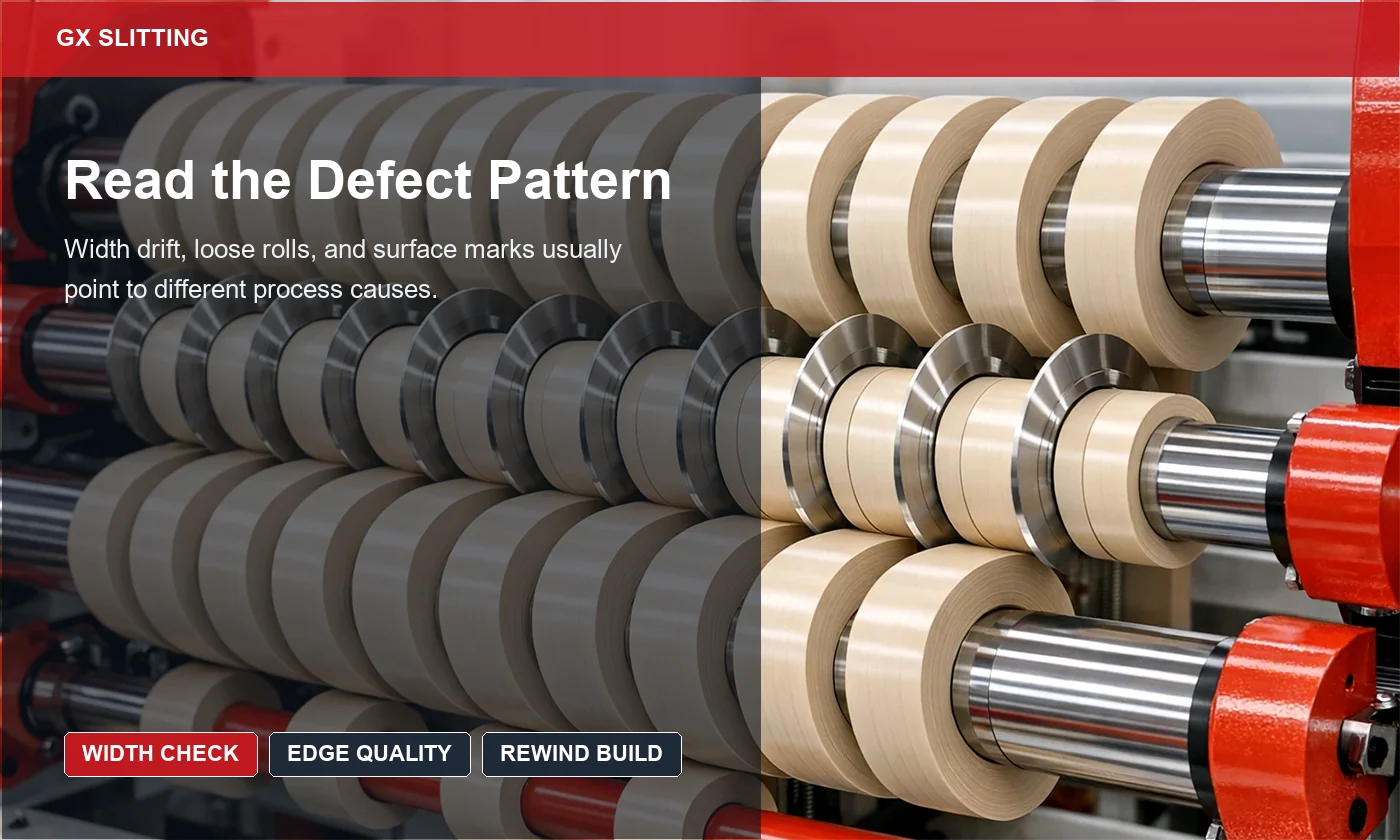
Width inconsistency is one of the first defects buyers mention because it is easy to measure and easy to compare across rolls. But “width problem” is still too broad. The buyer should ask whether the issue appears as a stable offset, a drifting result, variation between finished rolls in the same job, or instability that becomes worse on narrower widths. Those are not identical situations, and they do not point to the same response.
For PVC edge banding, width drift is especially important when the project includes many narrow finished widths or when the commercial tolerance window is tight. Narrow-width work increases the practical pressure on setup stability, repeatability, and the way the machine handles the real slit pattern over the course of production. If the defect mainly appears on smaller widths while broader widths stay acceptable, that is important buyer information and should be stated directly in the inquiry.
When buyers describe width inconsistency, they should include:
- the nominal target width
- the actual measured variation
- whether the issue is tied to specific slit widths
- whether it appears immediately or after the line runs for a period
- whether the issue is stable across the whole roll or changes during the run
Without that detail, suppliers can only guess whether the problem is mainly related to the job structure, the setup range, or the way the line behaves across the actual production window.
3. Edge-quality complaints and why they should be described more precisely
Another common defect category is edge-quality inconsistency. Buyers often report it as “edge not clean,” but that description is not specific enough to support good diagnosis. Edge complaints should be described in terms of what the operator or downstream user actually sees: unstable edge appearance, repeated inconsistency on certain widths, visible edge deterioration after particular changeovers, or a quality gap that becomes more obvious on specific PVC constructions.
For the quotation process, what matters is not that the edge is imperfect in an abstract sense. What matters is how the defect behaves in the real job. Does it worsen on narrower widths? Does it appear across the full thickness range or only at one end of the range? Does it become worse when the line is pushed harder? Is it tied to a particular finish type? When buyers answer those questions, the defect becomes a usable evaluation point rather than a generic dissatisfaction note.
Buyers should also distinguish between an edge complaint that is mainly cosmetic and one that is commercially critical. Some factories can tolerate small variation if the output remains saleable and efficient. Others need visibly cleaner and more stable results because downstream use or customer expectation leaves almost no room for variation. That commercial context changes how the supplier should interpret the complaint and what kind of machine discussion should follow.
Practical rule: if the buyer says “edge quality is bad,” the next message should explain on which widths, which PVC finish, and under which production condition the complaint becomes most visible.
4. Surface marks and finish-related complaints
PVC edge banding projects often involve decorative or visible finishes, so surface-condition complaints matter more than they might in a less appearance-sensitive converting job. A line may still be technically producing output while creating marks, handling traces, or finish-related quality issues that make the rolls commercially unacceptable. Buyers should therefore avoid treating surface complaints as secondary details.
When describing surface marks, it helps to state where the mark appears, whether it is repeatable, whether it correlates with one finish type more than another, and whether it becomes worse under higher output pressure or repeated handling. Even if the buyer cannot identify the exact cause, those observations tell the supplier whether the complaint should be thought about as a finish-protection problem, a broader handling problem, or a job-structure problem that appears only under certain operating patterns.
For surface marking, include two or three clear photos of the decorative finish and finished roll. State when the marks first become visible, which widths or finishes are affected, and whether they repeat in the same position. This gives the supplier a clearer basis for reviewing the web path and handling conditions.
5. Loose rolls, telescoping, and unstable rewind build
Many buyers describe the project as a slitting issue when the main commercial complaint is actually in the rewind result. Loose rolls, telescoping, or uneven roll build are especially important in PVC edge banding because downstream handling and finished-roll presentation often matter as much as the cut itself. A roll can be slit to nominal width and still become commercially problematic if the rewind is unstable.
To describe this defect well, buyers should state whether the issue appears on all widths or mainly on smaller finished widths, whether it becomes worse as the roll diameter increases, and whether it is consistent across the order mix or tied to certain jobs. It is also useful to say whether the complaint appears at the machine, during storage, or only when the roll is later handled downstream. Those details change how the supplier interprets the problem.
When the defect is telescoping or unstable roll build, the buyer should avoid sending only a complaint sentence. A better inquiry includes finished-roll photos, target diameter, width list, and a note on whether the issue is linked to narrow widths, higher output pressure, or a wider material range. That helps the supplier understand whether the project is mainly a rewind-stability discussion, a job-structure discussion, or a broader line-matching discussion.
6. Uneven quality after changeovers
Some PVC plants do not struggle with a stable repeating job. They struggle when the order mix changes often. In those cases, quality defects can cluster around changeovers: the first part of the next job becomes less stable, width consistency takes longer to settle, or finished-roll quality becomes less predictable after frequent setup shifts. This type of complaint is commercially important because it ties quality loss directly to the daily workflow of the plant.
Buyers should therefore say whether the defect is a steady-state problem or a changeover-related problem. If the line looks acceptable on long stable runs but becomes unreliable when widths change frequently, that is not the same buying case as a line that is unstable all the time. The quotation discussion should reflect that difference. One case is about broad operating stability across the real order mix. The other may be more about how the current process handles changeover pressure.
This distinction is also helpful when comparing suppliers. A strong supplier response should acknowledge whether the real problem is day-to-day width variation, rewind instability, finish sensitivity, or changeover-related inconsistency. If the response does not recognize that difference, the recommendation may still be too generic.
7. How to tell the supplier what the defect usually means in your plant
The article title says “what they usually mean” for a reason. A defect does not automatically prove one single cause. What it usually means is that the buyer should treat the defect as a clue about where more precise discussion is needed. Width drift usually means the supplier needs better information about the real slit pattern, range, and the way the line behaves across the actual production case. Surface marks usually mean the supplier needs better information about finish sensitivity and how the material is handled. Loose rolls and telescoping usually mean the supplier needs clearer information about rewind targets and where the instability appears.
In practical terms, buyers should explain the defect using four layers:
- What it looks like: width inconsistency, surface mark, loose roll, edge-quality issue, or unstable roll build.
- When it appears: all the time, on narrow widths, after changeover, under higher output, or only on certain finishes.
- How serious it is commercially: minor annoyance, recurring waste point, customer complaint driver, or reason for replacement project.
- What data supports it: photos, width list, roll targets, sample measurements, or current-machine notes.
That framework usually produces a much better supplier conversation than simply saying the current machine is not good enough.
8. What buyers should include in an RFQ when the project is defect-driven
If the project exists because the current line creates one of the defects above, the RFQ should say so directly. The inquiry should not be written as a clean-sheet purchase if the real reason for buying is to reduce width drift, improve rewind stability, protect finish quality, or reduce the quality loss that appears during frequent setup changes. The quotation should be matched to the actual pain point.
A defect-driven RFQ should include:
- material thickness range and finish type
- mother roll width and diameter
- finished slit widths and finished roll diameter
- photos or notes showing the visible defect
- whether the defect appears across all jobs or only certain jobs
- whether the project is replacement, expansion, or process upgrade
- which defect is commercially most serious
This is where the RFQ guide and the PVC application page should be used together. The RFQ guide structures the inquiry. The application page keeps the project tied to the real PVC converting case. Together, they reduce the chance of asking for a quote that sounds specific but still leaves the supplier guessing.
Best next step: if your current defect is already documented with width data, photos, or roll samples, send those details with the inquiry instead of only asking for a general machine recommendation.
9. Common diagnosis mistakes buyers make
- Using one broad complaint for several different problems. Width variation, surface marks, and unstable rewind should not be compressed into one vague sentence.
- Ignoring when the defect appears. A problem tied to narrow widths or frequent changeovers is not the same as a constant full-range problem.
- Describing only the defect, not the job. The supplier still needs the material range, width mix, and roll targets.
- Sending no photos when the complaint is visual. Pictures often clarify the production case faster than more generic wording.
- Asking for a quote before the defect is framed properly. A weak diagnosis usually leads to a weaker quotation.
10. Practical buyer checklist before asking for a defect-focused quotation
- Write the defect in plain language.
- Add when it appears and on which widths or finishes.
- State whether the problem is steady-state or changeover-related.
- Attach finished-roll photos or sample evidence if available.
- Include the normal slit pattern and roll targets.
- State whether this is a replacement or a new-capacity project.
- Use the RFQ guide before asking for final price.
FAQ
What is the most common PVC edge banding slitting defect buyers should mention in an inquiry?
There is not one universal defect. The most common inquiry topics are width inconsistency, edge-quality complaints, surface marks on visible finishes, loose rolls, telescoping, and unstable rewind build. The better question is which one is commercially most serious in your plant.
Should I treat loose rolls as a slitting defect or a rewind defect?
Usually it is more useful to describe it as a finished-roll stability defect. Buyers should explain when it appears, which widths are affected, and whether it worsens as the finished diameter increases.
Do I need to know the technical cause before I contact a supplier?
No. You do not need to diagnose every root cause yourself. But you should describe the defect clearly, say when it appears, and send the job data that lets the supplier discuss the real production case.
Are photos worth sending for PVC defect discussions?
Yes. For visible finish complaints, roll-build problems, or instability that is easier to show than describe, photos and sample images usually improve the quotation discussion.
Where should I go after identifying the defect pattern?
Move to the RFQ guide, the PVC machine page, and the PVC application page, then send the actual job data through the inquiry popup.
Written by GX Slitting. This guide is built around the defect patterns that most often appear in PVC edge banding quotation and replacement-line discussions.
If the current project is being driven by one recurring quality complaint, describe that complaint with the job data, not by itself. That is usually the difference between a generic answer and a recommendation that fits the real production case.
RFQ guide PVC machine page PVC application page Ask for a Quick Quote