Skip to content Skip to content
Buyers often say they want a fast quotation, but what they usually need first is evidence that the supplier understands the project they are actually trying to buy for. In PVC edge banding slitting, that difference matters. A supplier can answer quickly with confident language and still be reading a softer, easier, or more generic version of the job than the factory really runs. If the buyer cannot spot that early, the whole comparison process becomes less reliable.
Short answer: a supplier understands the real project when their questions and answers stay connected to the plant’s actual width mix, finish sensitivity, finished roll targets, complaint pattern, and reason for spending money. Buyers should judge understanding by the coherence of the supplier’s reading, not by general confidence, polished sales language, or speed alone.
Before comparing suppliers on price, check whether they are even talking about the same project. Review the RFQ guide, the quotation comparison article, and the PVC machine page before treating speed as proof of understanding.
1. Fast response is not the same as real understanding
A fast reply can be useful. It shows the supplier is active and willing to engage. But speed alone does not tell you whether they have understood the project. In many buying situations, the quickest reply is simply the broadest reply. It may be built on a generic reading of PVC edge banding work, a standard machine template, or a narrow interpretation of the RFQ that avoids the harder questions. That can look efficient at first and become expensive later.
Buyers should therefore separate response speed from project understanding. A supplier who asks two or three focused questions about width families, finished roll targets, finish-sensitive jobs, or the reason the line is being replaced may actually be doing stronger work than a supplier who sends a polished number immediately. The important distinction is whether those questions make the project clearer.
A useful supplier response should refer to your actual material, width mix, roll sizes, and quality concerns. If important requirements are missing from the recommendation, ask how they will be assessed before comparing quotations.
2. Good suppliers usually restate the project in their own words
One of the clearest signs of real understanding is that the supplier can restate the project coherently. They may not use the buyer’s exact wording, but their response should show that they understand what kind of PVC work matters, what the exposed width groups are, what output quality the factory is trying to protect, and why the project exists. If they cannot do that, they may still be answering the category instead of the case.
This restatement does not need to be formal. Sometimes it appears through a short summary inside an email or call. Sometimes it appears through the questions they choose to ask. The important thing is that the supplier sounds like they are looking at your plant’s work rather than at a generic slitting machine brochure in their head.
Buyers should pay close attention here because misunderstandings are often visible early. If the supplier keeps restating the project as an output expansion while the factory is really trying to remove narrow-width instability, the mismatch is already present.
3. Strong supplier questions usually improve the project definition
Not all supplier questions are equal. Strong questions usually make the project sharper. They expose missing width-family priorities, unclear finished roll targets, weak sample context, or an undefined replacement reason. Weak questions often feel random, repetitive, or disconnected from what the buyer already explained. Buyers should learn to tell the difference because questioning style is one of the best early signals of supplier quality.
For example, good questions may ask:
- Which width family actually drives the complaint pattern?
- What happens to finished rolls after rewinding?
- Is the project mainly replacement, capacity increase, or correction of a known instability?
- Which finish-sensitive jobs matter most commercially?
- Does the current line fail mainly in steady running or after changes?
Those questions build a better shared project definition. They are not slowing the process randomly. They are reducing future guesswork.
4. Generic confidence is a weak signal
Buyers naturally want reassurance, but reassurance without project detail is not a strong buying signal. Phrases like “our machine can do this,” “we have many references,” or “this is no problem” may be true in a broad sense and still fail to answer the actual project. A supplier who really understands the project usually sounds less generic because they are reacting to the actual width mix and production risk rather than to the product category alone.
This is why buyers should be careful around very smooth supplier language that does not seem attached to the facts of the job. Confidence is useful only when it is anchored. If the supplier sounds certain but has not yet shown they understand the main width families, finished roll target, or finish sensitivity, that certainty is still thin.
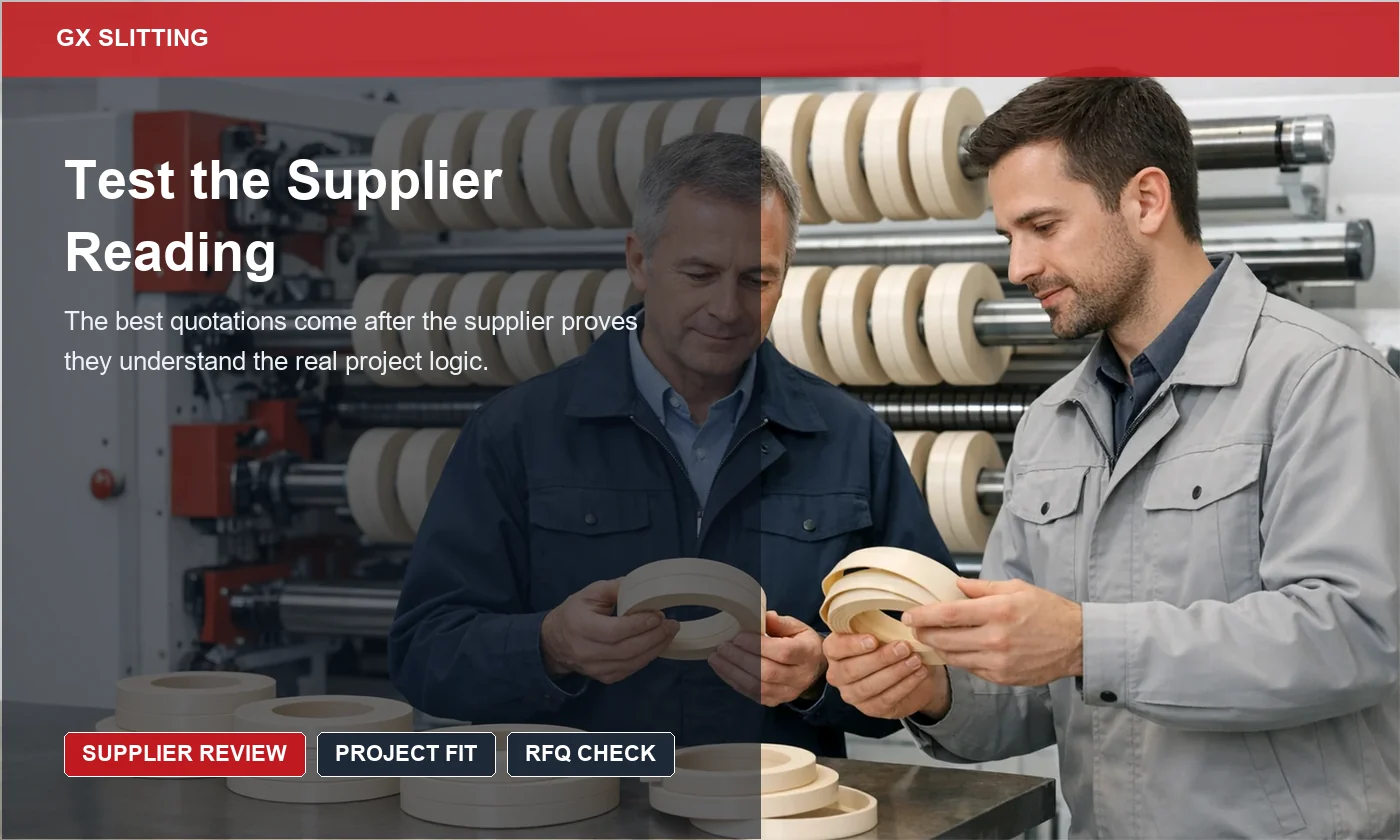
Good suppliers do not need to sound uncertain. They just sound connected to the actual case. That is a much stronger form of confidence.
5. The supplier should know why the factory is spending money
Many quotations become generic because the supplier never learns what is actually forcing the factory to spend. Are you trying to remove a narrow-width complaint? Replace a line that depends too heavily on one operator? Improve finished roll stability? Increase capacity while keeping finish-sensitive jobs reliable? If the supplier does not know the answer, they are likely to speak to the machine category rather than to the real buying case.
Buyers should therefore listen for whether the supplier keeps the project reason in view. If the main reason for buying disappears from the conversation and is replaced by broad product features, that is a warning sign. The supplier may still be competent, but they are not yet anchored to the plant’s decision logic.
A useful test is simple: after one or two serious exchanges, could the supplier explain to your team why this project exists? If not, understanding is still weak.
Practical buyer test: if the supplier cannot explain why the factory is spending money, they are probably still quoting the category instead of the real case.
6. Good suppliers pay attention to width families, not only to range endpoints
A weak supplier often talks as if the project can be understood by its widest width, narrowest width, and thickness range alone. A stronger supplier usually asks how the width families behave in actual production. They want to know which widths matter most commercially, which ones create instability, and how often the schedule moves through the more exposed cases. That is a much better sign because real projects are rarely defined by range endpoints alone.
Buyers should notice whether the supplier hears the width mix as a living production case or as a static technical table. The first response tends to lead to better recommendations. The second tends to lead to easier but less tailored quotations.
This is also where articles on slit pattern data and width-group priority become useful references. A supplier who understands those ideas is usually easier to compare seriously.
7. Strong understanding includes finished roll logic
Another clear signal is whether the supplier keeps finished roll targets in view. Many weak discussions stay trapped at the slitting stage and never get serious about what the plant actually needs after rewinding. A supplier who ignores finished roll behavior may still quote quickly, but they are more likely to miss the real output requirement the factory cares about.
Good suppliers usually ask how finished rolls need to behave downstream, whether narrow-width roll build is stable enough, and whether the current line already creates loose, uneven, or complaint-sensitive results. These are not side questions. They are evidence that the supplier is reading the whole job rather than only the cutting portion of it.
Buyers should count that as a positive sign. Finished roll logic is one of the places where real project understanding becomes visible.
8. Replacement projects reveal supplier quality very quickly
When the machine inquiry is a replacement case, strong suppliers usually ask what the current line does badly. They want to know whether the real problem is narrow-width consistency, changeover recovery, finished roll quality, operator dependency, or some combination of those things. Weak suppliers often skip that and start presenting a machine as if replacement alone were a full project description.
This is a useful dividing line for buyers. Replacement projects come with evidence. A supplier who is interested in that evidence is more likely to recommend responsibly. A supplier who does not ask for it may still offer a valid machine, but they are giving you less reason to trust that the recommendation is shaped by your plant’s real pain.
The strongest responses often sound more like diagnosis than pitch. That is usually a good sign.
9. Supplier understanding should survive comparison pressure
Some suppliers sound thoughtful early and become generic once price comparison begins. Buyers should watch for that shift. If the supplier stops referring to width-family priorities, finish-sensitive jobs, or finished roll targets once the discussion turns commercial, that may mean the project understanding was shallow to begin with. Real understanding should survive the move from technical clarification into quotation comparison.
This does not mean every email must repeat the full project summary. It means the supplier’s logic should remain consistent. They should still appear to be quoting the same project you described, not a simplified version designed to make the numbers easier to compare.
One reason the earlier article on quotation comparison matters is that buyers need a way to test whether supplier understanding remains attached to the quotation itself.
10. Red flags buyers should not ignore
Several patterns usually indicate weak project understanding:
- the supplier speaks broadly about PVC but never about your width families
- they ask no questions about finished roll targets or downstream handling
- they ignore the stated reason for replacement or investment
- their questions feel repetitive rather than project-building
- their recommendation sounds the same after you add important project detail
One red flag by itself is not always decisive. But several together usually mean the buyer should slow down and test the project definition more carefully before treating the quotation as fully comparable.
11. A checklist buyers can use before trusting the quotation
Before treating a supplier response as serious, the buyer team should be able to answer:
- Can the supplier explain the project in a way that matches our plant reality?
- Have their questions made the RFQ clearer?
- Do they understand which width families drive the decision?
- Do they know why the factory is spending money?
- Have they connected slitting discussion to finished roll expectations?
If the answer to several of these is no, then price comparison is probably happening too early. It is better to correct the project reading before treating the quotation as a final decision input.
12. Real supplier understanding reduces buying risk before price ever does
Buyers often focus on reducing price risk first. In practice, project-understanding risk is usually the earlier and more dangerous problem. A supplier who is quoting the wrong case can still produce a very neat quotation. The numbers may look structured. The machine may sound capable. But the whole proposal is still built on an incorrect reading of the plant’s work.
That is why the best buyers spend time judging understanding before they spend time negotiating numbers. They want to know whether the supplier sees the same project they see. If that foundation is weak, the quotation can only be partially trustworthy no matter how professional it looks.
In other words, supplier understanding is not a soft issue. It is one of the hardest practical filters in the whole buying process.
One simple way to test this before moving further is to ask the supplier for a short written summary of how they currently understand the project. Not a marketing overview. Just a plain project reading. Which width families matter most? What is the main reason for investment? Which output risks appear central? What information is still missing? A strong supplier can usually answer that clearly and without much drama. A weak one often falls back into general machine language.
That written summary is useful internally as well. It lets purchasing, production, and management see whether the supplier is genuinely aligned with the plant’s reality before time is spent on deeper negotiation. If the summary already sounds like the wrong project, the buyer has learned something valuable early.
This is also where buyers can raise their standard. A supplier does not need to be perfect on the first exchange. But they should become more accurate as the discussion develops. If more detail goes in and the supplier’s reading does not become sharper, that is a serious warning sign.
That standard helps prevent a familiar waste pattern: weeks of quotation comparison built on project ambiguity that could have been spotted in the first few serious exchanges. Buyers who test supplier understanding early usually make stronger shortlists, ask better follow-up questions, and spend less time negotiating against proposals that never really matched the plant’s work in the first place.
That is why supplier understanding should be treated as a qualification step, not as something to judge casually after the prices arrive. Once the wrong project reading enters the quotation stage, it becomes much harder to cleanly compare anything that follows.
Strong buyers filter for this early and save themselves a large amount of avoidable comparison noise later.
That filter also improves internal discipline. When purchasing, production, and management can all hear that the supplier is responding to the same real project, the whole decision path becomes cleaner. When each side hears a different version of the job inside the supplier’s answer, that confusion usually turns into slow comparison, repeated clarification, and weaker commercial confidence.
That is usually a better use of time than rushing into negotiation with suppliers who still sound like they are quoting a different factory.
Buyers who keep that filter in place usually protect both project quality and comparison quality at the same time.
FAQ
How can buyers tell whether a PVC edge banding supplier understands the project?
Look at whether the supplier’s questions and answers stay connected to your width mix, finished roll targets, finish sensitivity, complaint pattern, and reason for spending money.
Is a fast quotation a good sign?
It can be, but not by itself. A fast quote may simply be broad. Buyers should judge whether the supplier has actually read the real project before treating speed as a positive signal.
What kind of supplier questions are usually useful?
Questions that clarify width-family priority, finished roll behavior, replacement logic, sample meaning, and the true production pain behind the inquiry are usually valuable.
What is a strong warning sign?
A strong warning sign is when the supplier keeps answering the product category in general and does not adjust their logic even after you provide more specific project detail.
Before comparing suppliers on price, make sure they have earned the right to be compared on the same project.
Review quotation comparison Prepare the RFQ Ask for a Quick Quote