Skip to content Skip to content
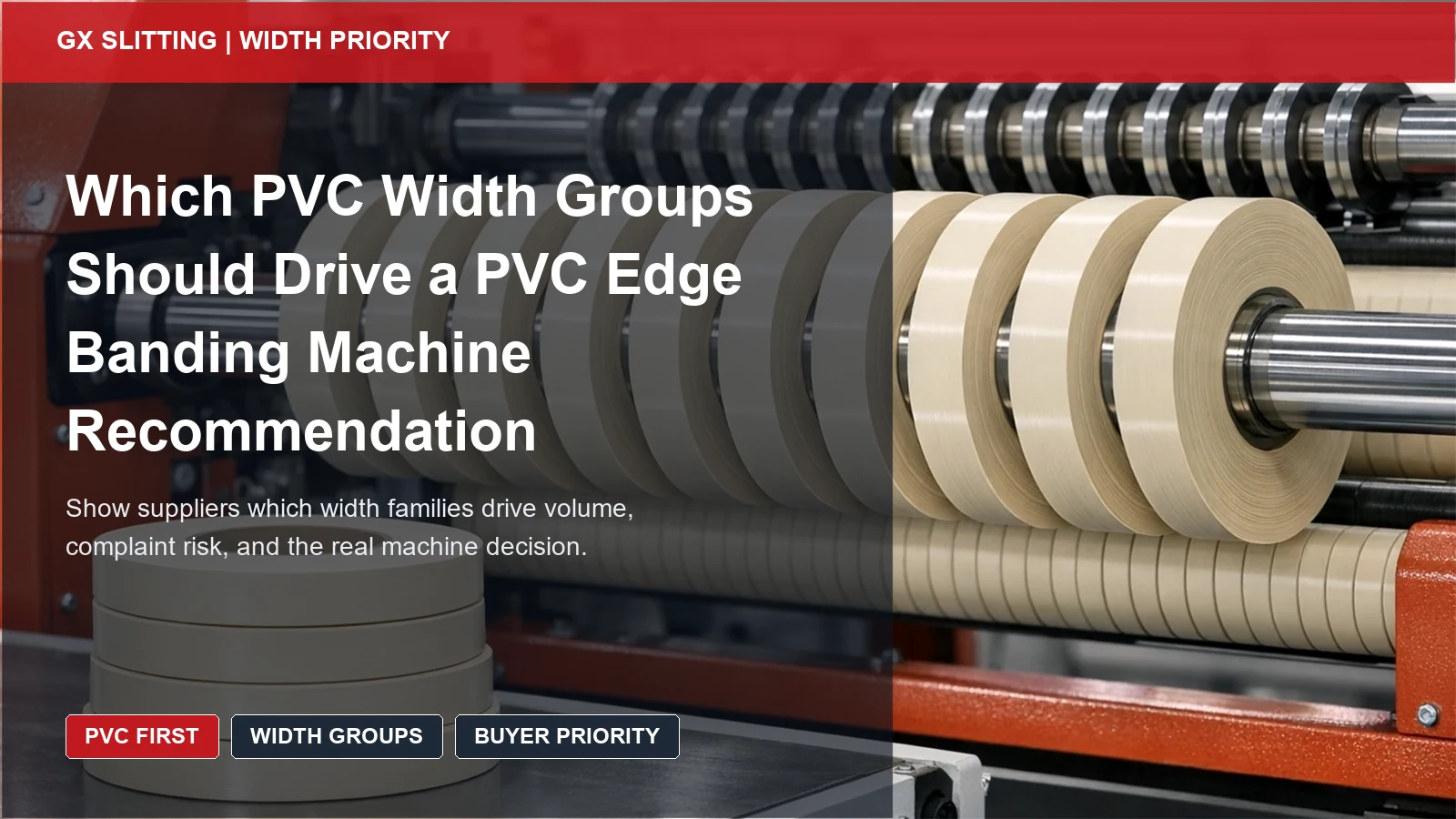
One of the quietest problems in PVC edge banding RFQs is that every width in the range is presented as if it deserves equal weight. On paper that looks balanced. In real buying work, it often weakens the project. Some width groups are easy and frequent. Some are difficult but commercially important. Some are narrow enough to expose the real limits of the current line. If the supplier does not know which width groups actually drive the decision, the machine recommendation may be built around the average instead of around the width families that matter most.
Short answer: the width groups that should drive the machine recommendation are the ones that control commercial risk, complaint risk, and daily production pressure. Buyers should identify which widths are normal volume, which widths are operationally demanding, which widths expose weakness in the current line, and which widths matter most to the business. A supplier who can see that hierarchy can recommend a line more honestly than one who only receives a long flat width list.
If one width family decides whether the line feels safe or fragile in daily work, that width family belongs at the center of the RFQ. Review the slit pattern guide, compare with the PVC application page, and check the RFQ guide before sending only a full width list.
1. Not every width belongs at the same decision level
Factories often organize width data in a simple way: list everything the line may need to run and send that list to the supplier. That is necessary, but it is not enough. A supplier still needs to know how those widths function inside the business. Some widths are routine and forgiving. Some carry most of the output value. Some create the highest complaint risk. Some are rare but difficult. Without that hierarchy, the supplier sees a range but not the real project.
This is why machine recommendations sometimes feel oddly generic even when the RFQ contains plenty of numbers. The numbers are there, but the weight is missing. The supplier does not know whether the project should be judged by the easiest recurring widths, the narrow exposed ones, or the width family that currently creates the most schedule pressure. As a result, the recommendation may drift toward the safest interpretation of the range.
Good buyers fix this by ranking width groups according to how they matter in factory life. That does not require a complicated scoring model. It requires clarity about what the plant actually cares about.
2. Commercial importance and technical difficulty are not always the same
A width group can be commercially important without being technically difficult. Another can be technically difficult without carrying much business volume. A third may be both. Buyers should separate those cases because the machine recommendation should not be driven blindly by only one of them. If volume dominates the discussion, the difficult widths may be under-read. If difficulty dominates, the supplier may over-build the project around a small edge case.
The right question is not simply “which width is hardest?” It is “which width groups define success for this plant?” That may include the volume core, the width family that creates most complaints, or the narrow group that makes the current line feel unreliable during normal work. The answer depends on the factory, not on a universal rule.
This is one reason why strong supplier conversations often begin with width families rather than isolated widths. Families describe actual production logic better than single numbers do.
3. The current line usually reveals which width groups matter most
If the plant already runs PVC edge banding, the current line has already taught the team where the real pressure sits. Some width transitions are easy. Some width families require extra attention. Some are where finished roll confidence drops, complaints rise, or schedule rhythm slows. That evidence should directly shape the RFQ because it shows which width groups deserve the most weight in the next machine recommendation.
Buyers sometimes hide this by sending a neutral list of all widths as if the supplier should infer the pressure points alone. That wastes one of the best pieces of information the factory already owns. The supplier does not need to guess where the current line struggles if the plant already knows.
A better approach is simple: identify the width groups that are commercially normal, the groups that are difficult, and the groups that trigger the project. Those groups may overlap. They may not. The point is to make the structure visible.
4. Narrow widths often deserve more weight than their volume suggests
Many plants learn that narrow widths are not the majority of volume yet still deserve disproportionate attention in the machine recommendation. The reason is practical. Narrow widths often expose width stability, finished roll build, finish sensitivity, and changeover recovery more clearly than broader easier jobs do. They may not dominate tonnage, but they can dominate risk.
This does not mean every recommendation should be built around the narrowest possible width. It means buyers should ask whether the narrow-width family is where confidence breaks down. If it is, then the supplier should be told that this width group has more decision weight than a simple volume chart would suggest.
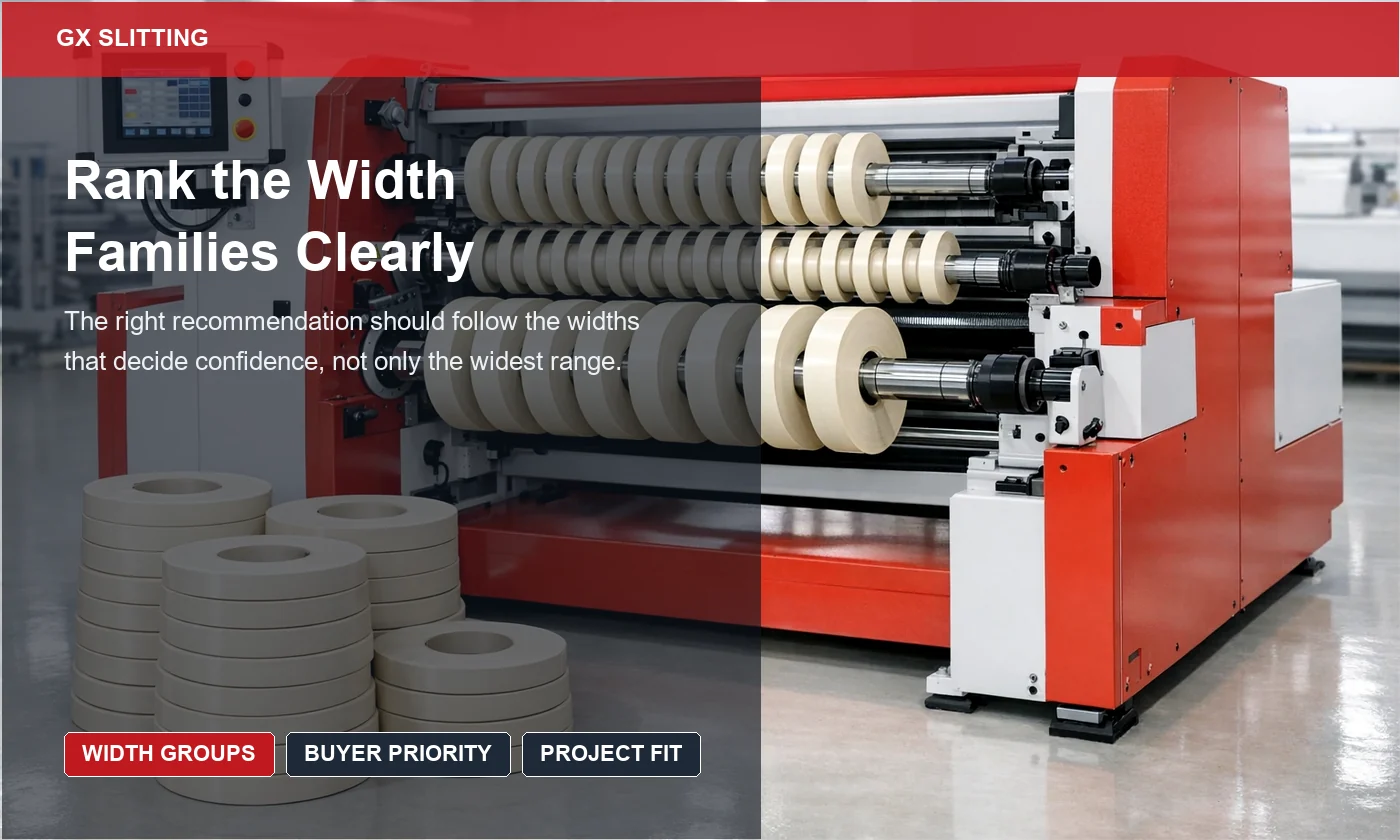
This is also where buyers can distinguish between a complete width list and a decision-driving width list. Both are useful. They are just not the same thing.
5. Order rhythm can make one width family more important than another
Width importance is not only a matter of frequency or difficulty. It is also a matter of rhythm. A width family that appears repeatedly through the day may create more changeover pressure, more operator attention, or more downstream disruption than another family that is technically difficult but operationally rare. Suppliers should know that because machine recommendations are ultimately judged in the rhythm of production, not in isolated width examples.
For example, a plant may run one narrow-width family often enough that even moderate instability becomes expensive. Another narrow family may be more difficult in theory but rare enough that the factory can manage it as a special case. Those differences should be visible in the RFQ. Otherwise the supplier may place the wrong width family at the center of the recommendation.
This is why changeover and width prioritization belong together. The plant is not buying for a spreadsheet. It is buying for a schedule.
Useful buyer rule: the width groups that most often create downtime, complaint risk, or operator rescue should usually have more weight than a flat RFQ table suggests.
6. Suppliers need representative width families, not a symbolic average
Some buyers summarize the whole project through one “typical” width. That can be useful for a first conversation, but it becomes misleading if it starts to stand in for the entire decision. A symbolic average width often hides the real question: what width families define whether this line will feel dependable inside the factory?
A better RFQ usually identifies three kinds of width family:
- the normal commercial core
- the family that exposes the most daily difficulty
- the family that drives the reason for spending money
Those categories are often enough for a supplier to read the project correctly. They make the width mix interpretable. They also help the buyer compare supplier responses more intelligently because the supplier can no longer hide inside a broad average answer.
7. Width-family priority should be tied to finished roll expectations
Width groups do not exist in isolation. They should be tied to the finished roll target, because some families matter more precisely because they produce the most fragile finished rolls. If a broad width runs well but the narrow family creates unstable finished rolls, then the recommendation should not be judged mainly by the broad case. The line must be judged where the output starts to lose reliability.
This is why buyers should tell the supplier whether each width family has a different roll-build expectation or complaint history. A family that is easy to slit but difficult to rewind cleanly may deserve more decision weight than a family that is wider and calmer.
The article on finished roll quality helps on this point. The width group that drives the recommendation is often the width group where finished roll behavior begins to matter most.
8. Supplier comparison becomes easier when width groups are prioritized
One supplier may answer against the broad normal widths. Another may answer against the exposed narrow family. If the buyer has not stated which family should drive the recommendation, both responses may appear reasonable while actually describing two different projects. That is a poor basis for comparison.
Prioritizing width groups fixes much of this. The buyer can tell suppliers which width family is central, which is secondary, and which is occasional. That does not prevent suppliers from discussing the full range. It simply makes it harder for them to answer against the easiest reading of the project.
Good comparison depends on shared project definition. Width-family priority is one of the clearest ways to create it.
9. Production and purchasing should agree on the width hierarchy first
Width-family prioritization often breaks down because different departments are thinking about different measures. Production may focus on which widths are hardest to run. Purchasing may focus on which widths are most common. Sales may focus on which widths carry the most customer sensitivity. None of those views is wrong, but the RFQ becomes weak when they are not combined into one project story.
A strong internal discussion usually asks three questions. Which width families drive volume? Which drive pain? Which drive spending? When those are answered together, the supplier receives a much clearer map of the project. When they remain separate, the RFQ turns back into a flat list.
This internal step does not need to be formal. It just needs honesty. The buyer side should know which widths actually define success before expecting the supplier to know it.
10. A practical note buyers can add to the RFQ
Most suppliers do not need a complex matrix. A short width-priority note is usually enough. It can say:
- which width family is the normal production core
- which family creates the most operational sensitivity
- which family is central to the complaint or replacement case
- how often those families appear in the schedule
- whether any width family should be treated as an occasional edge case
This turns width data into decision data. It also makes follow-up questions easier to read. A supplier who understands the project will usually respond in the same width-family logic. A supplier who does not will tend to fall back into general machine language.
11. A checklist before asking for the recommendation
Before requesting a final recommendation, the buyer team should be able to answer:
- Which width family carries the most commercial weight?
- Which width family exposes the current line’s weakness?
- Which width family creates the most daily schedule pressure?
- Which width family is difficult but occasional enough to treat differently?
- Have we shown the supplier this hierarchy clearly?
If those answers are unclear, the recommendation is likely to be broad and harder to compare. Clarifying them usually improves quotation quality faster than asking for another round of price revision.
12. The right recommendation is usually built on the width family that decides confidence
Every plant has a width family that decides whether the line feels trustworthy. It may not be the widest. It may not be the narrowest. It may not even be the highest volume. But it is the family that determines whether the machine recommendation actually matches factory reality. Buyers should identify that family and put it in front of the supplier clearly.
Tell the supplier which width groups run most often, which cause the greatest quality or setup difficulty, and which are occasional orders. Ask the supplier to explain how those priorities affect the recommended knife setup and rewinding arrangement.
The best machine recommendations are not built on the easiest interpretation of the width range. They are built on the width groups that decide whether the factory can run with confidence.
A practical way to keep this visible is to create a one-page width-priority summary before the final quotation round. It does not need complex formatting. A short table with width family, job frequency, complaint risk, and buying importance is often enough. That gives both the buyer team and the supplier a shared reference point when the conversation starts drifting back toward a flat range description.
This step is especially useful when several suppliers are being compared at once. If every supplier receives the same width hierarchy, the buyer has a much stronger basis for judging whether each response is really addressing the same exposed production case.
It also helps the plant resist a common mistake late in the buying process: letting a smooth broad quotation pull attention away from the width family that originally triggered the project. A visible width-priority summary keeps the conversation anchored to the widths that actually decide confidence, complaint risk, and real production value.
That anchor is valuable because width-family priority often drifts unless somebody keeps it explicit. Once quotations arrive, it becomes easy for the conversation to slide back toward easy averages. A clear priority note makes that harder.
It also gives management a cleaner way to see why one width family deserves more attention than its raw volume alone might suggest.
That clarity is often what turns a broad machine discussion into a recommendation that can actually survive daily factory use.
Without it, buyers often end up comparing answers to a width range instead of answers to the real production problem inside that range.
It also gives suppliers a fairer chance to respond well. A good supplier can only prioritize the right width family when the buyer has shown which family carries the complaint risk, schedule pressure, or commercial exposure. When that hierarchy is missing, even a serious supplier is more likely to answer against the easiest interpretation of the project rather than against the widths that actually decide confidence.
FAQ
Should the most common width always drive the machine recommendation?
No. The most common width may matter, but the recommendation should also reflect width families that create complaint risk, narrow-width instability, or daily schedule pressure.
Why should width families be prioritized instead of listed equally?
Because suppliers need to know which parts of the width range are commercially central, which are operationally difficult, and which actually drive the buying decision.
Do narrow widths always deserve the most weight?
Not always. They often deserve more weight than their volume suggests, but buyers should judge them against complaint risk, frequency, and the real reason the project exists.
How can buyers show width priority clearly in an RFQ?
Use a short note that identifies the normal core, the difficult family, the complaint-driving family, and any occasional edge cases that should be treated separately.
The width groups that drive the buying decision should be visible in the RFQ before the supplier ever talks about machine scope.
Review slit pattern guidance Check the narrow-width guide Ask for a Quick Quote