Skip to content Skip to content
Factories do not replace a PVC edge banding slitting line because the old machine suddenly became unfashionable. Replacement happens when daily compromises pile up to the point that management no longer trusts the line to support the work cleanly. Width variation keeps showing up. Finished rolls do not build the same way from shift to shift. Narrow widths remain nervous. Changeovers interrupt too much time. Operators know the machine’s weak moods by heart. Production keeps moving, but everyone knows the line is starting to cost more than it appears to on paper.
Short answer: before replacing a PVC edge banding slitting line, production managers should document the actual failure pattern of the current line, the normal slit-pattern mix, the quality boundary the plant must hold, the changeover rhythm, and the finished roll targets that matter downstream. Replacement decisions are stronger when the team can describe what the old line does badly and what the new line must do better in daily production.
If your team is already discussing replacement, do not begin with model names. Begin with plant evidence. Review the PVC machine page, the capabilities page, and the RFQ guide before you ask suppliers to quote.
1. Write down why the current line is being replaced
This sounds obvious, but many teams skip it. The project is discussed in broad terms like “capacity upgrade” or “machine replacement,” while the real reason sits in a mess of daily irritations that never gets written down clearly. Production managers should force that clarity early. Is the old line being replaced because finished roll quality is unstable? Because narrow widths keep creating complaints? Because the machine can still run but wastes too much time during changes? Because the line only behaves when the most experienced operator is standing there? Those are very different replacement cases.
Once the reason is written plainly, supplier conversations get better. The inquiry stops sounding like a routine machine request and starts sounding like a real production project. That matters because good suppliers respond better to a defined problem than to a vague wish for a newer line. The replacement case should sound like something the plant has lived with long enough to understand, not like a brochure request copied from a general website.
There is another reason to do this. Internal alignment improves immediately. Purchasing, production, and management often use different language for the same problem. A short written statement of the replacement reason prevents the conversation from drifting into three separate projects with one budget attached.
2. Separate machine weakness from material inconsistency
Some factories are quick to blame the line for every unstable result. Sometimes that is justified. Sometimes the material coming into the line changes enough to cloud the diagnosis. Before replacing the machine, production managers should look honestly at whether the failure pattern follows the line itself, the incoming material variation, or an unstable combination of both.
This is not an argument for delaying replacement. It is an argument for replacing with a clearer technical picture. If the new inquiry ignores material variability and treats every complaint as purely mechanical, the replacement line can be scoped in the wrong way. If the plant genuinely faces a broad thickness window, finish sensitivity, or different slit-pattern groups across orders, those realities should be part of the replacement logic.
Good replacement planning therefore begins with a simple question: when the current line performs badly, is it tied to certain widths, certain finishes, certain operators, certain order types, or all of the above? The answer helps separate the core process problem from the noise around it.
3. Use the monthly slit-pattern mix, not one demonstration job
A replacement decision should be based on the work the plant actually runs, not on the cleanest sample order anyone can find. Production managers know this, but replacement meetings still drift toward easy examples because they are convenient. That makes the incoming supplier discussion weaker than it should be. A line that handles one tidy slit pattern well is not necessarily the right replacement for a plant that spends most of its time balancing a mixed monthly schedule.
The better practice is to pull the common slit patterns from recent work and identify the patterns that create the most operational stress. Usually that includes the narrower widths, the more change-heavy orders, or the finished roll targets that cause downstream complaints when rewind build is inconsistent. These are the patterns that should shape the replacement conversation.
If you only show suppliers the easiest jobs, you are inviting a quote for the easiest version of your factory. That rarely ends well. Replacement projects earn their value when the new line is matched to the work that currently exposes the plant’s weakness.
4. Check whether the real pain is quality, output, or workflow
Managers often say the line is not meeting production. That is true often enough, but it can mean several different things. The problem might be actual output volume. It might be that quality failures keep slowing throughput. It might be that frequent changes destroy the day even though the machine performs reasonably during long steady runs. It might be that the line creates too much dependence on a small number of operators who know how to nurse it through sensitive jobs.
Before replacement, the plant should name the dominant pressure. If the real pain is workflow, then a replacement discussion focused only on top speed will miss the point. If the real pain is visible quality instability, then a discussion built entirely around capacity numbers will stay too high above the practical problem. The new line should be matched to the pressure the factory is actually trying to escape.
This is where production managers add the most value. They can translate broad complaints into daily process language. They know whether the line is frustrating because it cannot keep pace, because it cannot hold consistency, or because it turns routine scheduling into a constant recovery exercise.
5. Document the narrow-width behavior of the current line
In PVC edge banding work, the narrow end of the width range often reveals whether a line is really suited to the plant. Broad, stable work can hide weaknesses for a while. Narrower widths usually do not. If replacement is under discussion, production managers should document what happens in those narrow cases. Does width drift increase? Do finished rolls build unevenly? Do operators slow the line to stay out of trouble? Does the complaint rate climb? This kind of evidence is far more useful than general dissatisfaction.
When suppliers see that the replacement project is especially sensitive in narrow-width work, the conversation becomes more practical. The line is no longer being judged only as a generic slitter rewinder. It is being judged against the part of the work that actually costs the plant money and patience. That almost always leads to a better scoping conversation.
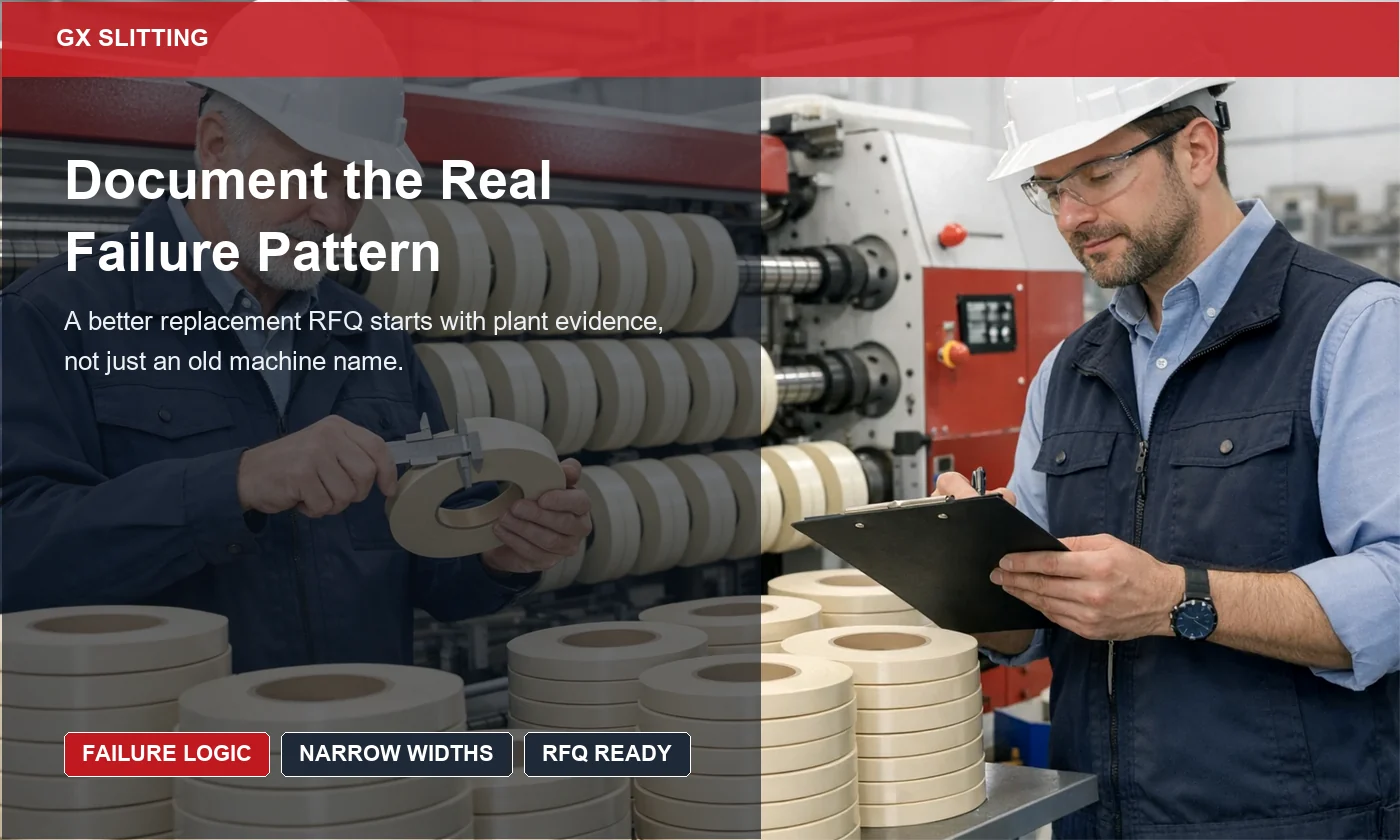
Even simple records help here. You do not need a formal engineering study. Photos, short shift notes, order references, and a list of repeat width groups can be enough to make the replacement discussion more concrete and much less speculative.
Useful test: if the current line behaves badly only at the narrow widths that matter most commercially, your replacement case is already stronger than a generic “upgrade” label suggests.
Review the PVC application page Send Your Current Line Issues
6. Check what the downstream team actually complains about
Production managers should not rely only on what the machine itself appears to be doing. They should also ask downstream people what they are actually receiving and what they complain about first. Sometimes the issue that drives replacement is not what the slitting team would describe most urgently. Operators may be focused on a line that feels unstable. Downstream people may be focused on rolls that look inconsistent, unwind badly, or create trouble later in the process.
These downstream complaints matter because they define the commercial weight of the replacement. If the new line only improves conditions at the machine while failing to improve what downstream teams experience, the project may still feel disappointing. Replacement should therefore be tied to the output condition that the rest of the plant has to live with, not only to the internal feeling that the old machine is tired.
A short downstream checklist is enough. Ask which complaint happens most often, which one is most costly, and which one would matter most if solved. Then make sure supplier discussions address those points directly.
7. Do not replace one bad workflow with another expensive workflow
It is possible to buy a technically stronger line and still end up with a workflow that frustrates the plant. This happens when replacement is scoped around one strong performance number while daily operating rhythm is treated as secondary. Production managers should test whether the new quotation reflects the actual job rhythm. How often do widths change? How often do order batches interrupt one another? Are there recurring width groups that deserve to be treated as the main operating case rather than as exceptions?
If the replacement discussion ignores workflow, the team may choose a line that looks good in a clean run but still creates too much friction in day-to-day scheduling. This is not rare. It happens because speed is easy to compare and workflow is harder to describe. Managers need to do the harder part.
That is one reason replacement planning should not be left entirely to a generic supplier questionnaire. The plant has to explain its own rhythm in plain language. A good supplier can then respond in a way that is useful. A poor supplier will keep talking as if every line lives in the same production calendar.
8. Check how much operator dependency is hiding inside the old line
Some lines keep running mainly because a few experienced people know how to work around their weaknesses. They know how to react to certain width combinations, how to judge unstable build early, and how to coax acceptable results out of sensitive jobs. Management sometimes underestimates how much tacit operator skill is holding the process together. Before replacement, production managers should make that dependency visible.
Why does it matter? Because a replacement project that ignores this issue may compare suppliers as if the old line were performing neutrally. In reality, the old line may only seem acceptable because skilled operators are absorbing its weaknesses. The new line should be assessed against what the plant needs under normal staffing conditions, not against heroic shift work.
This also helps RFQ quality. If operators consistently need to intervene during narrow-width work or changeovers, say so. That is useful buying information, not an embarrassment to hide. It tells the supplier where the line currently costs the factory labor, attention, and daily confidence.
9. Build a replacement RFQ from plant facts, not only from old machine specs
One common shortcut is to copy the old machine’s specification sheet and use it as the core of the new RFQ. That can save time, but it is often not enough. Old machine specs tell suppliers what the line was supposed to be. They do not always tell suppliers what the plant has learned from living with it. Replacement RFQs should therefore include both the known specifications and the known failures.
That second part is what makes the RFQ worth reading. Tell the supplier where width variation appears, which finished roll issues cause rejection or complaint, how often slit patterns change, and which material ranges produce the most trouble. When suppliers receive that kind of input, their quotations become more grounded and more comparable.
The best replacement RFQs read like practical plant documents. They say, in effect: this is what we run, this is where the current line struggles, and this is what the next line must stop costing us. That kind of RFQ removes a lot of empty conversation from the buying process.
10. Decide what “better” must mean before suppliers define it for you
Suppliers will naturally describe improvement in ways that fit their own sales process. Production managers need to define improvement before that happens. Does better mean more stable finished rolls? Fewer complaints in narrow widths? Less dependence on a senior operator? Faster recovery during changes? Higher confidence when a less forgiving material lot comes in? If these points are not named clearly, the replacement discussion can drift toward whatever is easiest to present, not whatever is most useful to the plant.
This is not about being rigid. It is about protecting the project from vague success criteria. Once the plant knows what “better” means, quotation comparison becomes more disciplined. Managers can ask whether each supplier is actually aiming at that result or simply selling the broad promise of a newer line.
In practice, one or two outcome statements are usually enough. For example: hold width more consistently on the narrow widths that drive most complaints; reduce the instability in finished roll build that slows downstream work; or shorten the operational disruption caused by frequent slit-pattern changes. These are real replacement goals. They can be discussed. They can be quoted against. They can be checked later.
11. The best time to involve purchasing is before the quote, not only after it
Production managers sometimes collect the replacement case on their own and hand it to purchasing only when it is time to gather numbers. That is late. Purchasing should be involved before the RFQ goes out so that commercial comparison and technical comparison grow from the same base. When purchasing understands the plant evidence early, they are less likely to push suppliers into an artificial price race based on an incomplete job description.
This helps the production side too. Purchasing often notices ambiguity that technical teams overlook because they know the factory too well. If the replacement reason, slit-pattern mix, or quality requirement is not written clearly enough, purchasing will feel that problem during the quote stage. Better to fix it before suppliers are asked to respond.
When production and purchasing align early, supplier communication gets cleaner. The plant sends fewer mixed signals. The resulting quotations are easier to compare because they were invited onto firmer ground.
12. What production managers should send before the first supplier call
Before the first serious supplier discussion, production managers should prepare a compact evidence set. It does not have to be elegant. It does have to be honest. Include the main material range, the common slit patterns, the narrow widths that create the most difficulty, the finished roll targets, the most repeated complaint, photos if useful, and a note on whether the project is replacement for quality, workflow, capacity, or a combination. If there is an old line, note what it does well too. Replacement should keep the parts that already work.
That evidence set is usually enough to move the conversation away from vague machine talk and toward a real replacement plan. Suppliers can then ask better questions, and the plant can judge who is listening to the actual problem instead of simply trying to send the fastest offer.
Factories that do this well rarely regret the extra preparation. They may spend more effort at the beginning, but the replacement decision usually becomes calmer, more transparent, and more defensible inside the company.
FAQ
What is the first thing a production manager should check before replacing a PVC slitting line?
Write down the actual failure pattern of the current line. Replacement gets much better once the team can say plainly whether the pain is width drift, finished roll instability, changeover pressure, operator dependency, or a mix of these.
Should replacement planning rely on the old machine specification sheet?
No. The old specification sheet is useful, but it only describes the machine on paper. A replacement RFQ should also describe what the plant has learned from running that machine in real production.
Why are narrow widths so important in replacement discussions?
Because they often expose the weakness of the current line more clearly than easy, stable jobs do. If the business depends on those widths, replacement planning should treat them as central rather than marginal.
How much detail does a supplier need before giving a replacement quotation?
Enough to understand the real work: material range, slit patterns, finished roll targets, the main complaint pattern, and whether the project is driven by quality, workflow, capacity, or all three.
If the current line is costing you patience every week, document the actual failures before you compare replacement offers. That usually improves both the quotation and the final decision.
Prepare the RFQ Review the flagship PVC machine Ask for a Quick Quote