Skip to content Skip to content
When buyers say they want better slitting quality, they often mean one specific thing: they want finished widths to stay where they should stay. Width variation is one of the fastest ways for a PVC edge banding project to lose trust inside the plant because it is measurable, visible in results, and hard to explain away once operators start checking roll after roll. But buyers also make a mistake here. They ask how to reduce width variation as if it were one single issue with one single fix.
Short answer: reducing width variation in PVC edge banding slitting usually starts with describing the real job more accurately. The supplier needs to know where the variation appears, on which widths, under which changeover or output conditions, and whether the complaint is steady-state or tied to part of the working range. Better machine matching matters, but better diagnosis and better RFQ data usually come first.
This is not only a troubleshooting topic. Width variation is one of the strongest signals buyers can send when a replacement or upgrade project is being justified.
1. Width variation is a symptom, not a complete diagnosis
Factories sometimes speak about width variation the same way they speak about temperature in a machine room: something is clearly off, but the reading itself does not tell the whole story. In PVC edge banding, width variation can be tied to the narrow end of the slit pattern, to certain changeovers, to certain thickness windows, or to the way the line behaves as the run continues. The visible problem is real, but the buying decision should not stop at the visible problem.
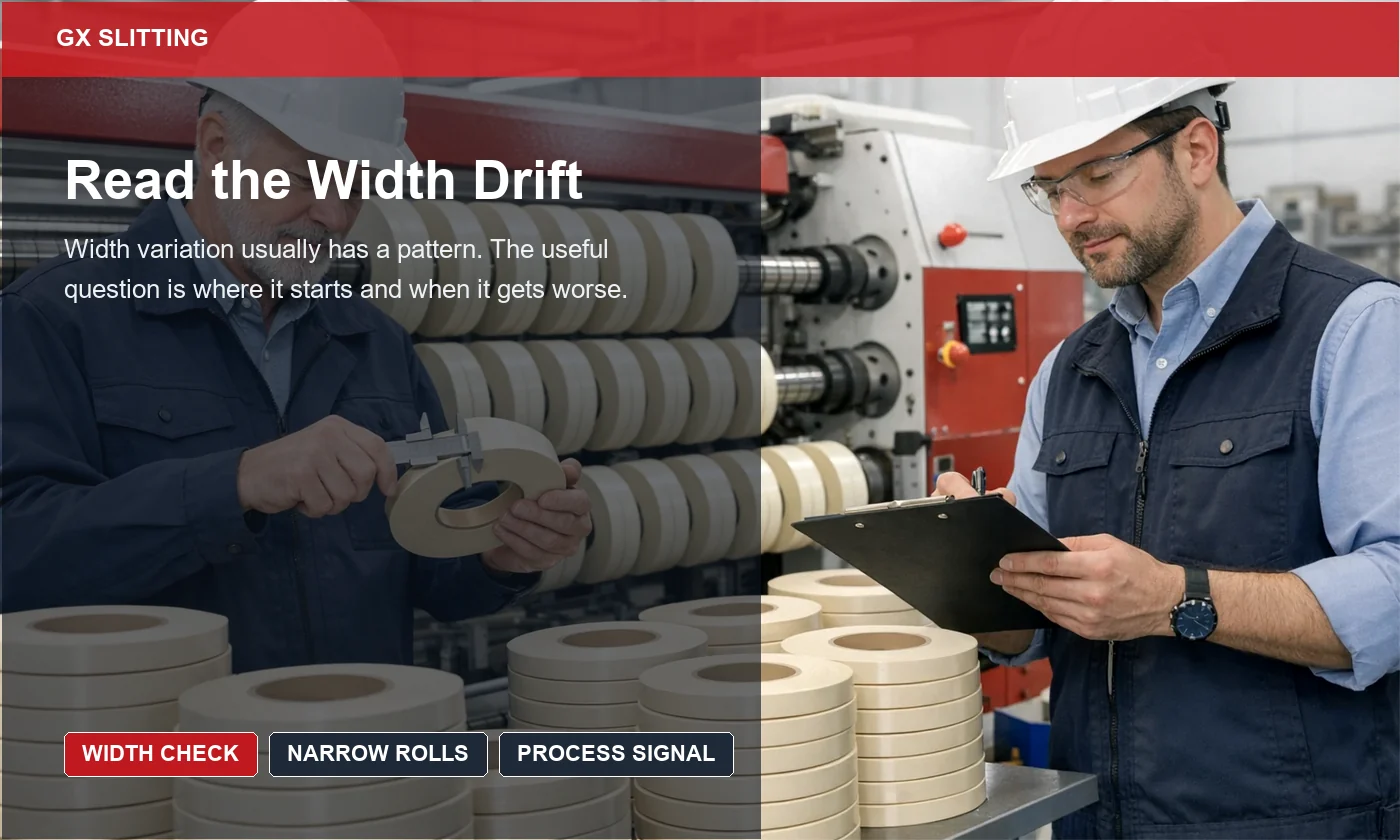
If the buyer wants a better quote or a better machine discussion, the first step is to describe how the variation behaves. Does it stay consistent as a fixed offset? Does it drift? Does it vary from finished roll to finished roll in the same job? Does it become worse after a width change? Those details change the conversation from generic quality complaint to useful evaluation point.
That is why buyers should not only ask, “How do we reduce width variation?” They should ask, “What kind of width variation are we actually seeing, and under what production condition?”
2. Narrow widths deserve separate attention
In many PVC edge banding plants, width variation becomes more commercially visible at narrower finished widths. That does not mean broad widths are irrelevant. It means the narrower widths usually reveal the pressure in the system faster. If a plant’s current line looks acceptable on more forgiving jobs but becomes unstable on narrow finished widths, that is important buying information. It tells suppliers that the quotation should be judged against the hard part of the commercial mix, not only against the easy part.
Buyers should therefore send the nominal target width together with the actual measured variation for the narrower widths that matter most. It also helps to say whether these widths are common daily jobs or only occasional exceptions. The answer changes how a supplier should think about machine scope. A line that struggles on rare edge-case widths is a different buying case from a line that struggles on widths the factory sells every day.
One thing buyers should avoid is sending the narrowest width alone with no broader context. That can make the project look more extreme than it is. The better approach is to send the narrow widths together with the common monthly mix and explain where the real quality pressure sits.
3. Changeover-related variation is not the same as steady-state variation
A lot of plants assume that if width variation exists, it exists in one stable way. In reality, some lines are relatively acceptable once they settle into a job but unstable when moving between jobs. Others drift even in steady-state operation. From a buying point of view, those are not the same problem. A line that suffers mostly around changeovers should be evaluated partly through workflow and practical setup behavior. A line that varies in steady-state deserves a different discussion around the real operating range and the way the job is being matched.
This distinction matters because buyers sometimes ask for “better accuracy” when what they really need is better repeatability through normal daily job changes. The supplier should hear that clearly. If width variation is mainly a changeover problem, say so. If it appears after longer runs or under higher output pressure, say that instead.
When the project is tied to replacement or upgrade, this one detail often changes the whole tone of quotation. It tells the supplier whether the plant is mainly asking for a line that holds better in one stable case or a line that behaves better across real production life.
4. Width variation should be linked to the slit pattern and the order mix
Buyers sometimes send width complaint data without linking it to the slit pattern. That makes diagnosis weaker than it needs to be. The supplier needs to know whether the variation appears in one specific width family, in certain mixed patterns, or across the whole range. This is one reason slit pattern data is so commercially useful. It does not only help the supplier quote the line. It helps the supplier understand how and where the quality complaint is being created.
For example, a plant may see acceptable results on a stable pattern and repeated variation on a mixed narrow-width pattern. Those are not the same buying case. One suggests the line has trouble under a more demanding job structure. The other may suggest the problem is broader. Without that pattern context, the buyer and supplier are both talking about width variation in a way that is too flat to be useful.
A simple table with width list, measured variation, frequency, and a short note about whether the pattern is commercially important can dramatically improve the quote discussion.
5. Better width control starts before the quote, not after installation
Many buyers think the path to better width control begins after the machine is delivered. In reality, it begins in the RFQ. If the width complaint is already known, then the RFQ should carry that complaint forward in a structured way. The supplier should know which widths matter, how variation is measured, and what the plant considers acceptable or unacceptable. That does not mean the buyer must provide a perfect engineering diagnosis. It simply means the quotation should be shaped by the real quality target.
This is one of the reasons people-first content matters on your site. The blog article should help buyers prepare better information, not simply repeat that “machine quality matters.” By the time a buyer finishes reading this page, they should know what width data to collect and how to present it. That is the useful next step.
In practice, better RFQ data also makes supplier comparison more honest. If all suppliers receive the same width-variation description and the same slit pattern context, their responses become easier to compare on a common basis.
Good buyer move: send not only the measured width variation, but also the widths on which it becomes most commercially serious.
6. What production and quality should prepare together
Width variation is one of those issues that benefits from short, practical coordination between production and quality. Production usually knows when the problem appears and which jobs make operators uneasy. Quality usually knows how variation is measured and which deviations create customer or downstream trouble. If those two views are combined before the RFQ is sent, the supplier receives a much more useful description of the case.
Useful internal notes include the nominal target width, actual measured variation, whether the complaint is recurring or intermittent, whether it is tied to specific finishes or thicknesses, and whether the issue appears mostly during setup changes or on stable runs. None of this requires a complex report. A short, well-organized note is enough.
The value of this step is not bureaucracy. It is clarity. It keeps the buyer from sending vague language like “accuracy needs improvement” and replaces it with something that suppliers can evaluate seriously.
7. How buyers should compare supplier responses to a width complaint
Once suppliers respond, the buyer should look for whether the response actually engages with the width complaint. Does the supplier refer to the real widths and patterns that were sent? Do they distinguish between narrow-width instability and broader range issues? Do they ask follow-up questions that show they understand where the problem appears? Those are the signs of a useful conversation.
A weak response usually sounds polished but generic. It may talk about machine precision in broad terms without engaging the real complaint. It may quote against the material name without acknowledging the measured variation or the production condition where the issue becomes serious. Buyers should recognize that as a warning sign. It usually means the supplier has not yet absorbed the actual problem.
The best supplier response is not always the one with the longest answer. It is the one that restates the problem clearly and shows how the quote is being matched to the real case.
8. How buyers should measure and report width variation cleanly
One simple reason width-variation discussions go nowhere is that different people inside the buyer team are reporting the issue differently. One person says the line is unstable, another says the width is drifting, and someone else says quality is bad on the smaller jobs. That language may all be true, but it is not yet a usable description. Buyers should align on one clean way to report the complaint before they send it out.
A practical report usually includes the nominal width, the measured deviation, the pattern in which it appears, whether it is recurring or intermittent, and whether it shows up mainly after changeover or under a stable run. That is enough to turn a complaint into something suppliers can reason about. It also helps the buyer compare supplier answers on a common basis.
This matters because the buying discussion gets much sharper when everyone is talking about the same version of the problem. Otherwise the supplier can reply to one interpretation while the plant is actually worried about another.
9. What buyers should avoid doing when width variation becomes a negotiation tool
Once a known width complaint is on the table, some buyer teams are tempted to use it only as leverage for price pressure. That usually weakens the conversation. The better move is to use the complaint as a basis for better project definition. If the supplier understands the real issue, price pressure can still happen later. If the supplier never fully understands the issue, negotiation happens on top of ambiguity and usually produces a weaker outcome.
Buyers should also avoid broad claims like “the current machine is not accurate enough” without showing where and how that inaccuracy is being experienced. Specificity tends to improve supplier discipline. Vague pressure tends to produce vague reassurance.
In the end, reducing width variation is a commercial goal, not just a technical slogan. The plant is spending money because the current situation is not acceptable enough. The more clearly the buyer can show that, the more useful the quote discussion becomes.
10. What a useful width-variation attachment looks like
Buyers do not need a complex quality dossier to discuss width variation well. A useful attachment can be as simple as a short table showing nominal width, measured deviation, the slit pattern in which it appears, whether it is recurring or intermittent, and one note on when it gets worse. If the plant already has photos or measurement records, those can be attached too. The goal is not to impress the supplier with paperwork. The goal is to give them a clean picture of what the factory is actually dealing with.
This kind of attachment has another advantage: it makes internal review easier. Purchasing, production, and quality can all look at the same sheet and agree on what the complaint really is before it goes out. That alone often improves the next round of supplier communication.
Width variation becomes easier to reduce once everyone is describing the same thing in the same way.
11. Why width variation should be tied to the business case, not only to tolerance numbers
Some buyer teams send width data as if the tolerance number alone tells the whole story. It does not. The same measured deviation can matter very differently depending on whether the width is commercially critical, whether the pattern is common, and whether the issue drives waste, complaint, or loss of confidence in the line. That context is what tells the supplier how serious the issue really is.
When the complaint is linked to the business case, the conversation improves. Suppliers can see why the plant is willing to invest and which part of the quality problem matters most. Buyers can also negotiate from a stronger position because they are no longer arguing in the abstract about “better accuracy.” They are explaining the commercial consequence of the variation.
This usually produces a much better quote discussion than sending raw numbers with no business meaning attached.
12. What a supplier should hear in one sentence
If a buyer had to summarize the width problem in one sentence, it should sound something like this: “The line loses width consistency on these specific jobs, under these specific conditions, and this is why it matters commercially.” That kind of sentence is simple, but it already does more work than vague phrases about better precision. It gives the supplier a starting point that is tied to the actual plant.
When that summary is backed by width data and pattern context, the conversation usually improves very quickly.
FAQ
What should I send if my main complaint is width variation?
Send the nominal width, measured variation, the slit pattern where it appears, whether it is tied to certain widths or finishes, and whether it is steady-state or changeover-related.
Do narrow widths matter more in this discussion?
They often do, because narrow widths usually expose the quality pressure more clearly. But they should still be presented in the context of the full monthly mix.
Should I ask suppliers to solve width variation only by quoting a “higher precision” machine?
No. It is better to describe how the variation behaves in real production. That gives suppliers a better basis for matching the recommendation to the actual job.
Why does the RFQ matter so much for this issue?
Because the quality of the quote depends on the quality of the problem description. A vague complaint usually produces a vague answer.
Where should I go next if this is our main complaint?
Use the RFQ guide, the PVC application page, and your slit pattern data together before asking for final quotation.
Written by GX Slitting. This article is built around the width-control questions that most often appear when PVC plants are evaluating replacement or upgrade projects.
If the factory already knows where width variation becomes painful, that information should shape the quote from the first round.