Skip to content Skip to content
If you choose a PVC edge banding slitting machine by brochure speed or headline maximum width alone, the quotation may look attractive while the machine still misses the real pressure points in production. For PVC edge banding, the real decision usually comes from slit width range, finish sensitivity, mother roll size, finished roll diameter, changeover rhythm, and the defect you are trying to reduce.
Short answer: the right machine is the one that matches your normal PVC job mix, not just your widest material or highest theoretical speed. Buyers should compare the machine against real slit patterns, thickness range, rewind quality expectations, and the information needed for a usable RFQ.
Need a practical starting point? If your main project is PVC edge banding, review the PVC edge banding application page, then compare it with the PVC Edge Banding Slitting Rewinding Machine page before sending the RFQ.
1. Start with the real PVC job, not the machine name
Many RFQs arrive with a simple request such as “PVC edge banding slitting machine” but without the operating details that actually decide the machine direction. That is not enough for a reliable recommendation. A machine that handles one PVC construction well may still struggle if the slit widths are much narrower, the decorative finish is more sensitive, or the finished roll diameter has tighter stability requirements.
Before you compare models, define the normal production case:
- PVC thickness range
- finish type or surface sensitivity
- mother roll width and unwind diameter
- minimum and maximum finished widths
- finished roll diameter target
- core size
- typical number of slit rolls per job
- changeover frequency across SKUs
- current defect or efficiency problem
That list matters because the machine is not only cutting material. It is also controlling web path stability, knife pressure, tension behavior, roll build, and changeover workload across the order mix. If the quotation is based on one sample width while the factory actually runs many narrow widths, the recommendation can look right on paper and still perform poorly in day-to-day production.
2. Match the machine to the slit pattern and order mix
For PVC edge banding, the slit pattern is often a better buying input than a broad sentence about the product family. Buyers should not send only the smallest width or only the widest width. The better approach is to send the common width groups and say how often the setup changes. That tells the supplier whether the real pressure is narrow-roll stability, faster setup, lower waste, or the ability to cover a wider mix without constant adjustment.
If your plant runs frequent width changes, the machine has to be evaluated for more than steady-state output. Setup logic, shaft arrangement, workable tension range, and the practical time cost of moving from one order mix to another become part of the buying decision. A machine that looks strong on a stable, repetitive job may be much less attractive when the factory changes widths all day.
For that reason, a useful selection discussion should answer these questions:
- Is the machine being sized around one demonstration job or the normal monthly mix?
- How many finished rolls are usually produced from one mother roll?
- Are narrow widths the commercial priority, or only an occasional case?
- How much downtime is acceptable between width changes?
- Is the main target higher output, lower waste, or more stable finished rolls?
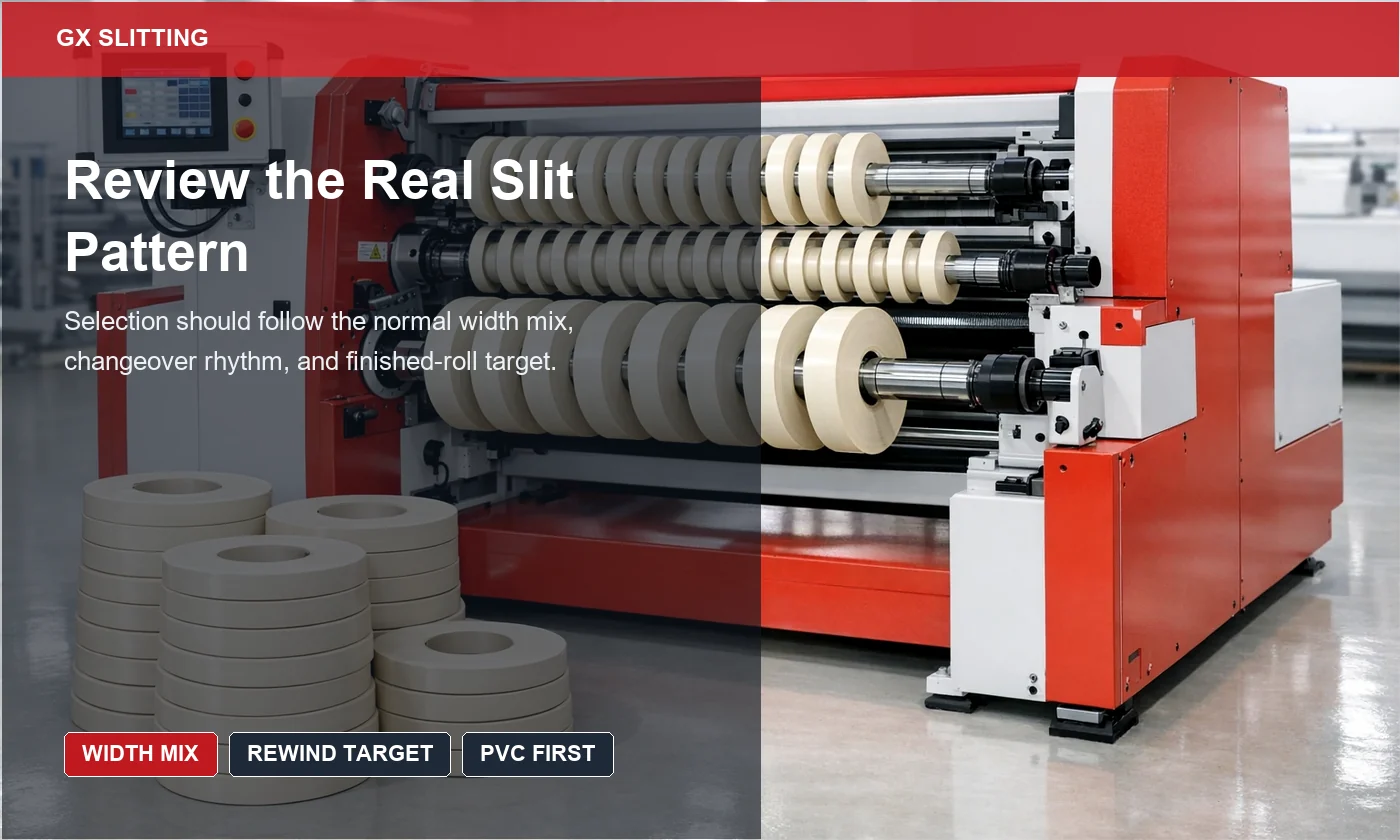
Selection rule: if the order mix is wide and the project includes many narrow finished widths, ask the supplier to comment on the normal slit pattern, not just the maximum machine width. That usually changes the recommendation faster than asking for more brochure data.
3. Check the finish, thickness range, and edge-quality target
PVC edge banding is not judged only by whether it can be cut. It is judged by whether the finished rolls remain commercially usable after slitting and rewinding. Decorative finishes, visible surfaces, and tighter narrow-width tolerances can make the machine decision more demanding than a general roll slitting job.
Thickness range matters because the machine has to stay stable across the actual material window, not just one middle value. Surface sensitivity matters because some jobs are more likely to show marks, edge issues, or quality complaints after handling. Edge-quality expectations matter because a supplier should explain how the proposed knife arrangement fits the material instead of offering a generic answer that could apply to any roll material.
When you evaluate a recommendation, ask the supplier to explain:
- why that knife setup fits your PVC construction and width range
- how the machine protects visible finish quality during web handling
- what part of the machine recommendation changes if the thickness range widens
- whether the proposal is aimed at narrow-width consistency, faster setup, broader range, or a compromise between them
If those answers stay vague, the quotation is probably still at the brochure stage rather than the real application stage.
4. Evaluate rewind quality, not only slitting quality
Some buyers focus heavily on the knife area and forget that many complaints appear in the finished roll. In PVC edge banding projects, rewind stability often matters as much as the cut itself. Loose rolls, telescoping, uneven build, or unstable finished roll hardness can turn an otherwise acceptable slitting result into a commercial problem for downstream use.
That is why the quotation should be reviewed against the real finished-roll target:
- finished roll diameter
- required roll hardness or stability
- minimum slit width
- normal production speed range
- acceptable defect level on finished rolls
If the current problem in the plant is not poor cutting but unstable finished rolls, ask the supplier to focus the recommendation on tension and rewind behavior instead of only knife details. Buyers often describe the project as a slitting problem even when the commercial complaint is really a rewind-quality problem.
5. Decide whether a standard machine scope is enough
Not every PVC project requires a heavily customized machine, but not every project should be treated as a standard case either. The right answer depends on how far your production conditions move away from a stable, repetitive operating window.
A more standard direction is often workable when the project has:
- a stable PVC thickness range
- a moderate width mix
- limited finish sensitivity
- consistent finished roll targets
- less frequent changeover pressure
A more application-specific direction becomes more reasonable when the project has:
- many narrow widths
- visible finish protection concerns
- higher sensitivity to roll-build consistency
- a broad monthly order mix
- a replacement project driven by current defects or downtime
This is where buyers should use the Slitting Capabilities page together with the PVC application and product pages. The goal is not to make the project sound complex. The goal is to avoid paying for the wrong machine scope, whether that means too little capability or unnecessary customization.
6. Send an RFQ that produces a usable quotation
Good machine selection depends on good input. If the RFQ only says “please quote PVC edge banding slitting machine,” the supplier has to guess too much. That increases quotation time and often leads to extra rounds of clarification.
At minimum, the RFQ should include:
- material construction and thickness range
- mother roll width and diameter
- finished widths and finished roll diameter
- core size
- target output or speed range
- number of finished rolls in the usual slit pattern
- main quality complaint or improvement target
- whether the project replaces an existing line or adds new capacity
That information is enough to move from a broad inquiry to a technically useful discussion. If your team already has sample photos, slit pattern sheets, or pictures of current finished rolls, send those as well. They often clarify the project faster than another paragraph of general description.
How purchasing and production should review the same machine
One reason buyers choose the wrong machine is that purchasing, production, and engineering evaluate the quotation from different angles but do not combine those views early enough. Purchasing may focus on price, delivery timing, and whether the supplier looks responsive. Production may focus on the widths that run most often, the time lost during setup changes, and whether the machine is likely to stabilize output across the real shift pattern. Engineering may focus on whether the recommendation actually answers the material range, knife logic, and roll-build issues that are driving the project. None of those views is wrong. The problem appears when the RFQ and the quotation are reviewed by only one side.
A better process is to split the evaluation into three short passes. First, purchasing checks whether the quotation is built on the real job data or on assumptions. Second, production checks whether the recommendation fits the normal slit pattern and the practical changeover rhythm. Third, engineering checks whether the explanation behind the recommendation is coherent: why this setup, why this range, and why this machine direction for this PVC case. When those three checks are done early, weak quotations usually reveal themselves fast. They either ignore the normal width mix, stay vague about finish protection and rewind quality, or rely too heavily on maximum values that do not matter in daily production.
This matters even more when the project is a replacement line. In that situation, the current machine has already taught the factory what usually goes wrong. The quotation should therefore be judged against known pain points, not only against advertised capability. If the current line loses time on width changes, produces unstable finished rolls, or struggles when the thickness window widens, the new machine discussion should address those exact issues. A supplier who can explain how the recommendation changes those daily pressure points is usually worth more attention than one who only repeats brochure language.
How to compare two quotations without getting lost in brochure language
Buyers often receive two quotations that look similar at first because both appear to cover PVC edge banding and both list acceptable speed and width numbers. The problem is that similar-looking quotations may be built on very different assumptions. One may be matched to the actual slit pattern and finish sensitivity, while the other may simply be broad enough to say yes on paper. That is why comparing quotations line by line without comparing the logic behind them can be misleading.
A practical comparison should begin with four checks. First, which quotation responds more clearly to the normal slit pattern rather than to one sample job? Second, which one speaks more directly to finish protection and rewind quality instead of only citing machine range? Third, which quotation is clearer about whether the scope is standard or more application-specific, and why? Fourth, which supplier has asked better follow-up questions about the actual job? Strong follow-up questions are usually a positive sign because they show the supplier is trying to match the machine to the real production case instead of pushing a generic answer.
It is also useful to separate “price gap” from “scope gap.” Sometimes a quotation is cheaper because it leaves more of the real application pressure unresolved. Sometimes a quotation is higher because it includes machine scope that the factory may not actually need. The right answer is not automatically the lower or higher number. The right answer is the quotation whose scope fits the commercial target with the least avoidable mismatch. That is why buyers should compare not only price and delivery, but also how each quotation handles narrow widths, changeover rhythm, finish sensitivity, and finished-roll stability. If one supplier is vague on those points, the lower number may only be lower because the machine is being judged against a simpler case than the one the plant really runs.
When in doubt, ask both suppliers to restate the project in their own words before final approval. A good supplier should be able to summarize the material range, common slit pattern, finished roll target, and main defect or commercial pressure. If they cannot do that clearly, they probably do not yet understand the application deeply enough for the quotation to be trusted.
Best next step for buyers: use the slitter rewinder RFQ guide to structure the inquiry, then send the real slit pattern and roll targets through the popup.
7. Common buying mistakes in PVC edge banding projects
- Buying around one sample width. The machine should be reviewed against the normal width mix, not only one demonstration job.
- Using speed as the main decision factor. Stable quality across the real order mix usually matters more than the highest brochure number.
- Ignoring rewind complaints. Many commercial complaints come from roll build, not only from the knife section.
- Sending too little RFQ data. Weak input creates slow quotation and weaker technical recommendations.
- Treating all PVC jobs as the same. Thickness range, finish sensitivity, width mix, and changeover rhythm can materially change the right machine direction.
8. Practical checklist before you decide
- List the real PVC thickness range and finish type.
- Prepare the normal slit pattern, not just one width.
- Define the finished roll diameter and stability target.
- Write down the current defect, waste issue, or efficiency problem.
- Confirm whether the project is standard replacement, capacity expansion, or a more custom case.
- Compare the recommendation against the PVC application page, the PVC product page, and the RFQ guide.
- Only then request the final quotation.
FAQ
What information should I send before asking for a PVC edge banding slitting machine quote?
Send material thickness range, finish type, mother roll width and diameter, finished widths, finished roll diameter, core size, target output, and the main quality problem you need to solve. A slit pattern list is usually more useful than a single sample width.
Do all PVC edge banding projects need a custom machine?
No. Some projects fit a more standard machine scope. A more specific configuration becomes more important when the width mix is broad, the finished widths are narrow, the finish is sensitive, or the project is driven by current defects and downtime.
Why is rewind quality such a big part of the buying decision?
Because many downstream complaints come from loose rolls, telescoping, uneven build, or unstable finished roll quality. A machine can cut material and still fail the real production target if the finished roll is not stable.
Should I choose by maximum speed?
Not as the main factor. Speed matters, but the better decision usually comes from matching the machine to the real slit pattern, thickness range, finish sensitivity, and finished roll target.
What is the safest way to compare suppliers?
Send the same RFQ data to each supplier and compare how clearly they respond to your real material, slit pattern, rewind target, and defect concerns. The quality of the technical explanation usually tells you more than a brochure summary.
Written by GX Slitting. This guide is based on the buyer questions that come up most often in PVC edge banding quotation and machine-matching discussions.
If your project already has clear width data and roll targets, move to the product and RFQ pages and send the actual job details. That is the fastest way to get a quotation that matches the real production case.
PVC Edge Banding Slitting Rewinding Machine PVC application page RFQ guide Ask for a Quick Quote