Skip to content Skip to content
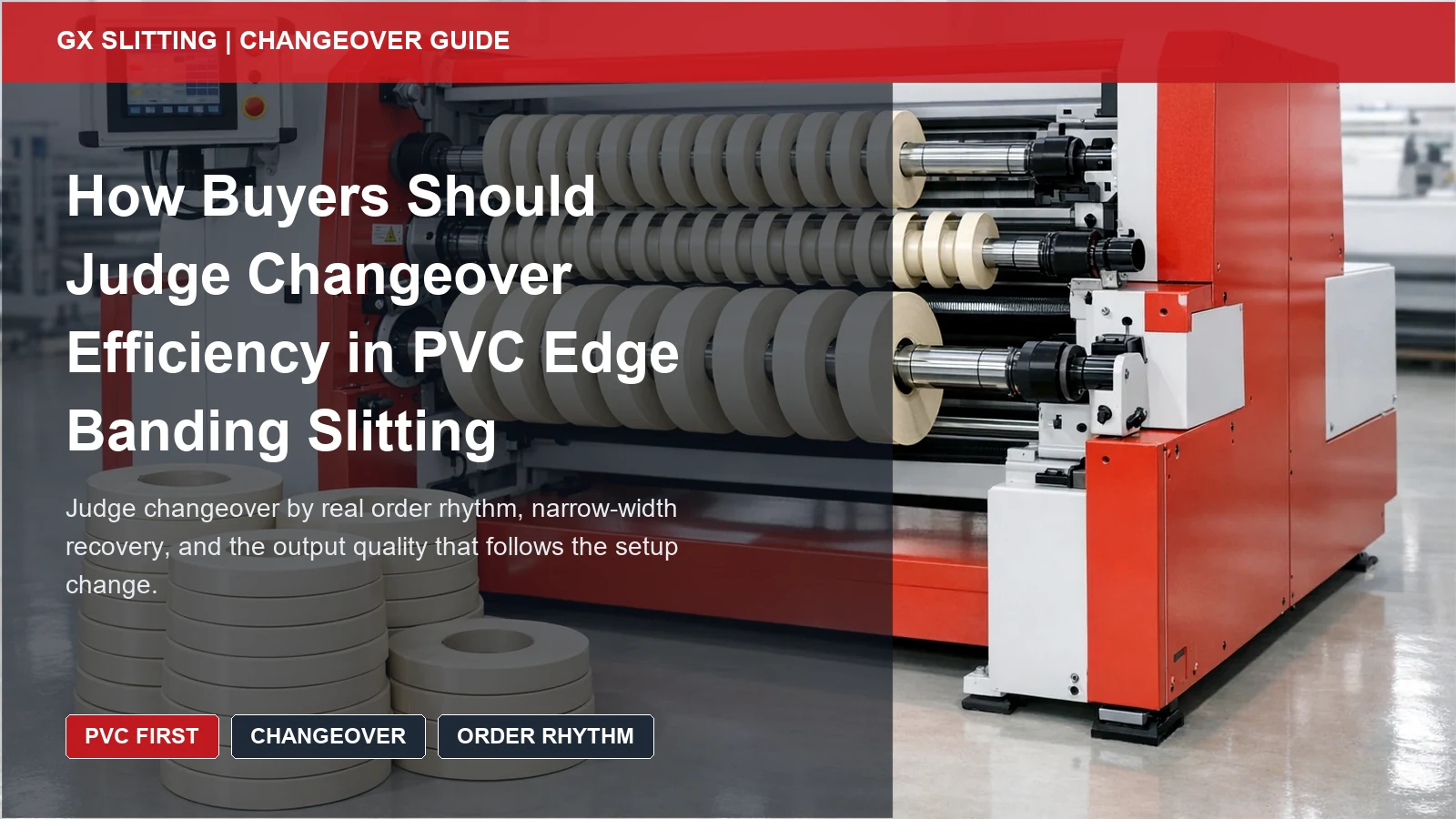
When buyers talk about PVC edge banding slitting performance, they often start with speed. That is understandable because speed is easy to say and easy to compare. But inside a real factory, the line rarely lives in one steady clean run all day. Width groups change. Orders are interrupted. Operators move from a familiar setup to a narrower, more sensitive one. What purchasing reads as line output is often shaped just as much by changeover efficiency as by steady-state running speed.
Short answer: buyers should judge changeover efficiency in PVC edge banding slitting by looking at what the factory actually changes, how often those changes happen, and how much stability is lost when the setup moves from one job to the next. A line that looks fast on a fixed demonstration case may still be a poor commercial fit if daily width changes eat time, create waste, or make narrow-width output harder to keep consistent.
If your factory changes widths frequently, treat changeover as part of the buying case, not as a secondary operator issue. Review the PVC application page, the capability page, and the RFQ guide before comparing suppliers only on headline output.
1. Why changeover matters more than brochure speed in many PVC plants
A line can look excellent when it is measured on one stable job, one width family, and one long clean run. Many factories do not live in that world. They live in a schedule where width groups change during the day, narrow widths appear often enough to affect planning, and operators have to recover quickly from one production case to another. In that environment, changeover efficiency is not a minor convenience. It is a major part of the line’s commercial usefulness.
Buyers sometimes underestimate this because changeover does not look as impressive on paper as a maximum speed figure. But if the plant loses too much productive time between jobs, or if the line becomes unstable after every width change, the practical output of the machine can be much lower than the brochure suggests. That gap between brochure performance and lived performance is exactly where many buying mistakes happen.
This is why serious buyers do not ask only how fast the line can run. They ask how the line behaves when the daily schedule interrupts the ideal case. A line that changes over cleanly and returns to stable production quickly can create more real value than one with a stronger headline speed but weaker daily flexibility.
2. Changeover efficiency is not just “how many minutes it takes”
Many buying teams reduce changeover to one timing question: how long does the change take? That is part of it, but it is not the whole story. A changeover that looks short on paper can still be commercially weak if it produces more waste, more narrow-width instability, or more reliance on a small number of highly experienced operators. Good changeover efficiency is really a mix of time, stability, repeatability, and how well the line returns to acceptable output after the change is made.
For PVC edge banding, this matters because some width groups and finish types are more sensitive than others. The transition back into good production is often where the hidden cost sits. If the line technically changes quickly but needs extra adjustment, extra operator attention, or a longer stabilization period before the output is truly acceptable, then the apparent changeover time is misleading.
Buyers should therefore think of changeover in two parts: the mechanical or setup portion, and the recovery portion. The first is what the team usually watches. The second is what often decides whether the changeover is commercially efficient.
3. The order mix decides how important changeover really is
Not every plant needs to treat changeover as a primary buying criterion. If the order mix is stable and the same width groups run for long stretches, then changeover may matter less than output stability on one main case. If the plant moves through many width groups, smaller batches, or a schedule that interrupts the day repeatedly, then changeover becomes much more important. Buyers should be honest about which type of factory they are buying for.
This is one reason why suppliers sometimes appear to disagree. They may not be disagreeing on the machine at all. They may be assuming different daily realities. One may think the line will run relatively stable work. Another may be hearing that the line lives in frequent changes and narrower, more sensitive widths. Those assumptions produce different quotations and different technical emphasis.
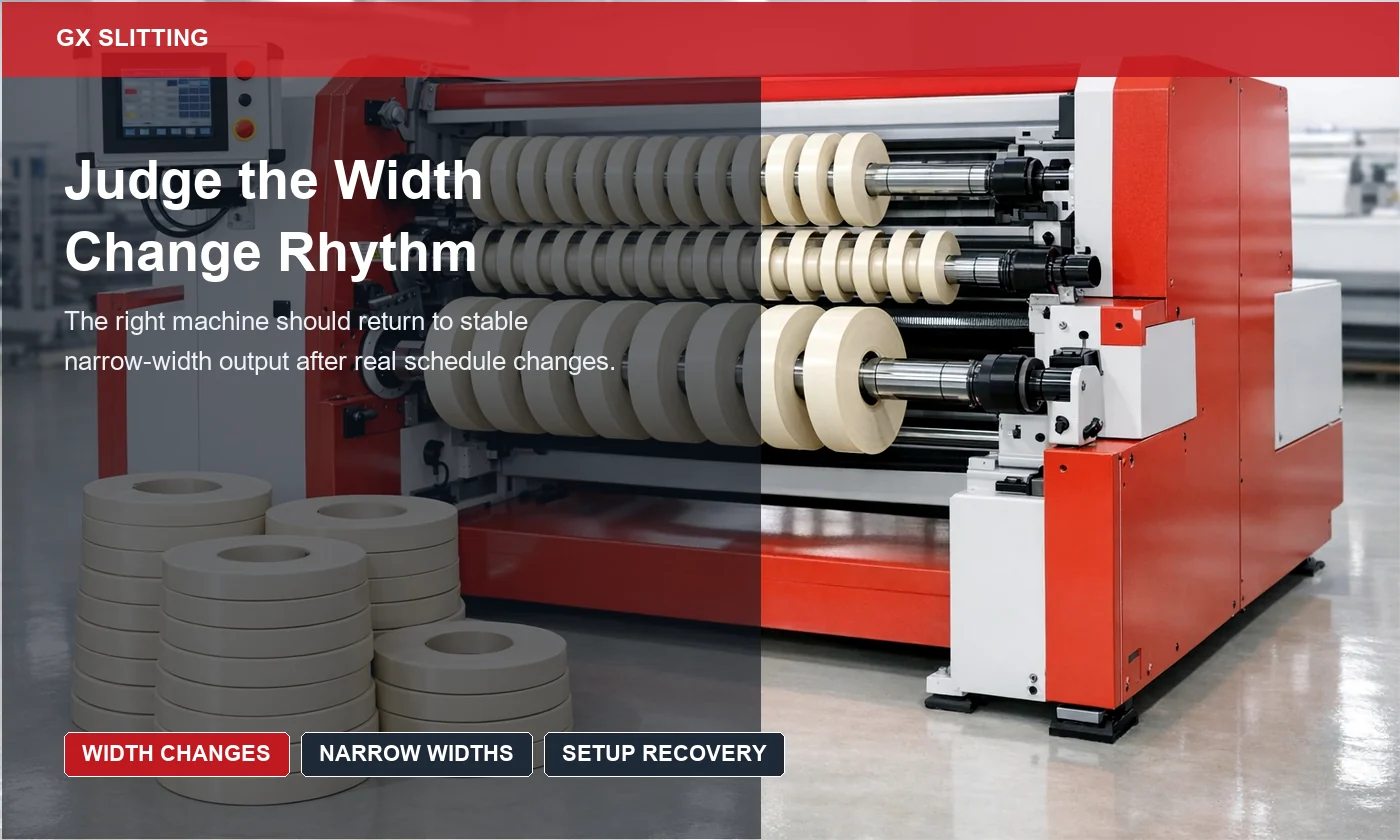
The right starting point is simple: describe the actual order rhythm. How often do width groups change? How often does production move from easier jobs into more sensitive narrow-width work? Which transitions create the most trouble? Once those things are clear, supplier answers about changeover start to become comparable.
4. Narrow-width work often exposes poor changeover discipline
In PVC edge banding plants, narrow widths often reveal whether a changeover is truly under control. A broader or more forgiving width group can hide weakness for a while. Narrower finished widths usually do not. If a line tends to lose consistency after changes, the narrow end of the production mix often shows it first through width drift, unstable roll build, or operators slowing the line to protect output.
This is why buyers should never ask about changeover in the abstract. They should ask how the line behaves after moving into the widths that matter most commercially and operationally. A supplier who talks confidently about changeover but cannot connect that answer to narrow-width reality is still speaking too broadly.
It also means that internal plant evidence matters. If the current line always becomes fragile after moving into one specific width family, that is buying information, not just shop-floor frustration. The next quotation should be tested against it.
5. What buyers should ask suppliers about changeover
Broad promises are not enough. Buyers should ask plain questions that tie changeover back to plant reality. Useful questions include:
- What part of the project makes changeover important in your view?
- Which width groups would you treat as the harder transition cases?
- After a width change, what part of output quality is most likely to need attention first?
- How should the line be judged in the first period after setup, not just in steady running?
- Does your recommendation assume a stable order mix or a more change-heavy schedule?
These questions are useful because they expose whether the supplier has actually understood the daily operating case. Good answers usually feel specific and connected to the project. Weak answers sound like generic machine confidence with little relationship to the real width mix.
Buyers should also notice whether the supplier asks good questions in return. Strong follow-up questions often indicate that the supplier is trying to match the changeover discussion to the actual plant rhythm rather than repeating stock phrases.
Useful buyer test: if the supplier cannot explain changeover against your normal width mix, they probably still do not understand the job deeply enough.
6. Production and purchasing do not judge changeover the same way
Production managers usually experience changeover as time, disruption, operator concentration, and what happens to output immediately after the line restarts. Purchasing often sees it more indirectly through schedule pressure, labor efficiency, and whether the machine recommendation appears flexible enough for the plant. Both views matter, but they are not the same. Good buying decisions combine them instead of letting one dominate.
If purchasing only asks how fast the machine can change, they may miss the quality and stabilization part of the problem. If production only focuses on the difficulty of setup without translating it into commercial language, purchasing may undervalue the issue. That is why internal alignment matters before supplier comparison begins.
A useful internal habit is to turn changeover pain into plain project language. For example: “the line loses too much stable output after moving into narrow widths,” or “the current process depends on one senior operator during busy width changes.” Statements like that help suppliers and decision-makers understand why changeover belongs in the quotation discussion.
7. Watch out for demonstration-case logic
Some machine discussions sound strong because they are still built around a demonstration case. The machine may indeed change well in a clean example, with one orderly move between familiar widths and no unusual production pressure around it. The buyer’s job is to ask whether that demonstration case resembles the plant or flatters the machine.
Demonstration-case logic becomes risky when the real factory changes between width groups more often, uses more sensitive narrow widths, or has a schedule that forces repeated interruptions. In that situation, the machine needs to be judged on how it returns to acceptable work under the plant’s daily rhythm, not on how it looks in a carefully chosen simple example.
This is also why case studies and application pages matter. They help buyers anchor supplier claims back to actual usage conditions. Without that anchor, a clean demo narrative can do too much work in the buying process.
8. A fast change is not useful if it increases waste
Some teams focus heavily on reducing the visible downtime of setup but pay too little attention to what happens immediately afterward. If the line returns quickly but produces more off-spec material, more unstable narrow-width output, or more finished rolls that need extra watching, the changeover is not truly efficient. It is simply shifting cost from visible time loss into hidden quality loss.
Buyers should therefore ask whether a faster change remains stable and repeatable. The right changeover is not only quick. It should also bring the line back into the intended width and roll-quality condition without a long soft period of adjustment. If that soft period is always present, it should be treated as part of the changeover cost.
This is one place where practical factory language is more useful than technical theater. Ask what usually happens to output in the first period after a change. The answer often tells you more than another general promise about efficiency.
9. Replacement projects should use the current line as evidence
If the project is replacing an existing line, the buyer already owns valuable information. They know which changes are easy, which width transitions create trouble, which operators the line depends on most, and where quality becomes fragile after setup. That evidence should be part of the new quotation discussion. Otherwise the replacement project risks forgetting the most useful lessons learned from the old machine.
Suppliers should be told what the current line does badly when widths change. Is the downtime too long? Does narrow-width stability suffer afterward? Does the line require extra operator attention every time the schedule moves into one difficult width family? These are powerful buying facts because they link the new machine to the real daily reason for replacement.
A quotation that ignores those known pain points may still look acceptable. It is just less likely to solve the problem the plant is actually paying to remove.
10. How buyers should document changeover pressure in the RFQ
Buyers do not need a formal industrial engineering report to make changeover visible in the RFQ. A short structured note is usually enough. Describe how often the line changes width groups, which patterns or width families create the most pressure, what the current line struggles with after setup, and whether the project is trying to improve time, quality, stability, or all three.
That note becomes much stronger when it is tied to representative slit patterns. If one pattern is stable and another consistently creates post-change instability, say so. The supplier then has a clearer basis for discussing the machine in the same language the factory uses internally.
Good RFQs do not hide changeover inside vague phrases like “needs to be flexible.” They tell the supplier what flexibility actually means in that plant.
11. A practical checklist for judging changeover efficiency
Before selecting a supplier, buyers should be able to answer:
- How often does the plant move between materially different width groups?
- Which width transitions create the most daily pressure?
- What happens to output quality right after those changes?
- Is the current pain mostly time loss, quality instability, or operator dependency?
- Has the supplier responded to the real order rhythm or to a simplified demonstration case?
If those answers are still unclear, the quotation is probably being judged too early. Buyers often gain more by clarifying this list than by asking for yet another round of price adjustments.
12. Use your production schedule to compare changeover requirements
Compare changeover claims against your actual daily schedule. Share the usual width changes, order lengths, setup tasks, and the time needed to achieve acceptable finished rolls. Ask each supplier which tasks are included in its changeover estimate and which depend on your operator or material.
Describe changeover with the tasks, timing, and output quality your production team can observe. Include how often each width change occurs and how long it takes to produce acceptable finished rolls after setup.
Factories that evaluate changeover this way usually make calmer decisions. They stop letting one speed number dominate the conversation and start choosing the line that fits the rhythm of the work.
That matters in search as well as in procurement. Buyers looking up changeover efficiency are rarely looking for a generic definition. They are usually trying to decide whether a quotation really fits a width-changing factory. An article that stays connected to that decision process is more valuable than one that treats efficiency as a detached technical slogan.
FAQ
What is the best way to judge changeover efficiency in PVC edge banding slitting?
Judge it against the real order rhythm, the widths that matter most, and what happens to output quality after the setup changes. Time alone is not enough.
Why do narrow widths matter so much in changeover discussions?
Because narrow widths often expose instability faster than broader, easier jobs do. If the line struggles after a setup change, narrow-width work is often where that weakness appears first.
Should purchasing care about changeover or leave that to production?
Purchasing should care because changeover affects the real output value of the machine. Production explains the pain in shop-floor language, but purchasing needs that information to compare quotations correctly.
Can a fast machine still be weak on changeover?
Yes. A line may look strong in steady running but still lose too much time, quality, or operator confidence when the daily schedule changes width groups frequently.
If your order mix changes all day, judge the line on how it changes, not only on how it runs once it is already stable.
Review capability points See the flagship PVC machine Ask for a Quick Quote